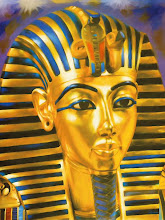
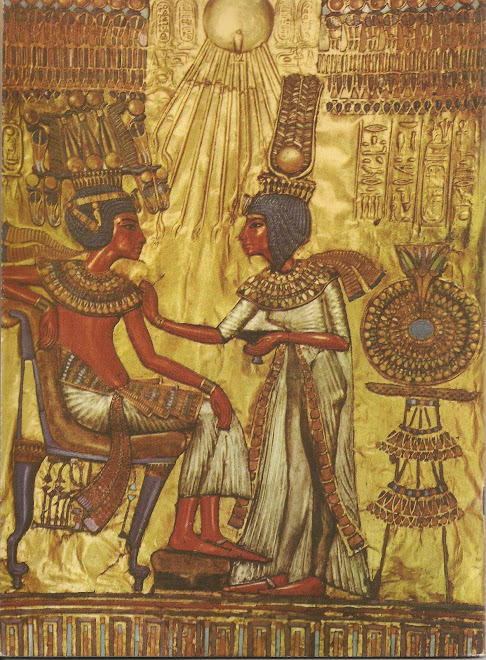
Pharaoh Akhenaten and his family adoring the Aten, second from the left is Meritaten who was the daughter of Akhenaten.

quarta-feira, 27 de julho de 2011

Literatura e Alquimia (Ensaios)


Biografia da Autora:


Nasceu em Lisboa, em 1940, de família de origem germano-polaca. Licenciou-se em Filologia Germânica pela Faculdade de Letras de Lisboa em 1963, tendo começado a leccionar como assistente na mesma faculdade no ano seguinte. Em 1974, passa a leccionar na Universidade Nova de Lisboa, onde é actualmente professora catedrática na área de Literatura Comparada e Coordenadora do Departamento de Estudos Alemães. Fundou e dirige o Gabinete de Estudos de Simbologia, assim como um núcleo de estudos 'Teatro e Sociedade'.

O teatro tem constituído para Yvette Centeno uma constante desde a juventude. Foi co-fundadora do CITAC, um dos mais importantes grupos de teatro universitário, de Coimbra. Desde então, para além da escrita para teatro, acompanha a actividade teatral do país, tendo sido convidada para o Conselho de Teatro (1987) e nomeada directora do I Festival Internacional de Teatro (Lisboa, 1991). É Directora do Serviço ACARTE da Fundação Calouste Gulbenkian.

Tem desempenhado cargos como consultora e comissária em várias iniciativas governamentais e de âmbito cultural , nomeadamente na Comissão de Qualidade do Cinema; Comissão Executiva da XVII Exposição Europeia de Arte, Ciência e Cultura; Comissão para as Comemorações do Cinquentenário da morte de Fernando Pessoa (em Londres); Grupo de peritos da Comissão das Comunidades Europeias para a tradução de obras literárias contemporâneas; Conselho Cultural da Fundação Culturgest, etc.

A sua obra, para além da poesia, do teatro e da narrativa — onde se destaca o tríptico constituído por Quem, se eu gritar?, Não Só Quem Nos Odeia e As Palavras, Que Pena, romances reunidos no volume Três Histórias de Amor —, conta com um considerável volume de ensaios. A unir todas as facetas desta obra, uma incursão pelos domínios do simbólico, que constitui um campo de investigação à volta do qual se tem estruturado, de uma forma ou de outra, o seu trabalho: a busca incessante da palavra que ligue, que una, que faça comunicar, as pessoas, as realidades, os mistérios.

Na obra ensaística, destacam-se as várias obras sobre aspectos da vida e da poesia de Fernando Pessoa.

É autora de traduções para português de obras de, entre outros, Stendhal, Goethe, Shakespeare, Brecht, Celan e René Char.

É Chevalier dans l'Ordre des Palmes Académiques por decreto do Primeiro Ministro Francês (1997) e foi condecorada com a Verdienstkreuz 1. Klasse, atribuída pelo Presidente da República Federal da Alemanha (1994).


Fonte: http://www.mulheres-ps20.ipp.pt/YVETTE_CENTENO.htm

Wook: http://www.wook.pt/ficha/literatura-e-alquimia/a/id/45770

Tratado da Pedra Filosofal e Tratado sobre a Arte da Alquimia


Sobre o Autor:

Tomás de Aquino OP (Roccasecca, 1225 — Fossanova, 7 de março 1274) foi um padre dominicano, filósofo, teólogo, distinto expoente da escolástica, proclamado santo e cognominado Doctor Communis ou Doctor Angelicus pela Igreja Católica.


Biografia

Tomás nasceu em Aquino por volta de 1225 , de acordo com alguns autores no castelo do pai Conde Landulf de Aquino, localizado em Roccasecca, no mesmo Condado de Aquino (Reino da Sicília, no atual Lácio). Por meio de sua mãe, a condessa Teodora de Theate, Tomás era ligado à dinastia Hohenstaufen do Sacro Império Romano-Germânico.[1] O irmão de Landulf, Sinibald, era abade da original abadia beneditina em Monte Cassino. Enquanto os demais filhos da família seguiram uma carreira militar,[2] a família pretendida que Tomás seguisse seu tio na abadia;[3] isto teria sido um caminho normal para a carreira do filho mais novo de uma família da nobreza sulista italiana.[1]


Aos cinco anos, Tomás começou sua instrução inicial em Monte Cassino, mas depois que o conflito militar que ocorreu entre o imperador Frederico II e o papa Gregório IX na abadia no início de 1239, Landulf e Teodora matricularam Tomás na studium generale (universidade) criada recentemente por Frederico II em Nápoles.[4] Foi lá que Tomás provavelmente foi introduzido nas obras de Aristóteles, Averróis e Maimônides, todos que influenciariam sua filosofia teológica.[5] Foi igualmente durante seus estudos em Nápoles que Tomás sofreu a influência de João de São Juliano, um pregador dominicano em Nápoles que fazia parte do esforço ativo intentado pela ordem dominicana para recrutar seguidores devotos.[6] Nesta época seu professor de aritmética, geometria, astronomia e música era Pedro de Ibérnia.[7] Aos 19 anos, contra a vontade da família, entrou na ordem fundada por Domingos de Gusmão. Estudou filosofia em Nápoles e depois em Paris, onde se dedicou ao ensino e ao estudo de questões filosóficas e teológicas. Estudou teologia em Colônia e em Paris se tornou discípulo de Santo Alberto Magno que o "descobriu" e se impressionou com a sua inteligência. Por este tempo foi apelidado de "boi mudo". Dele disse Santo Alberto Magno: "Quando este boi mugir, o mundo inteiro ouvirá o seu mugido."

Foi mestre na Universidade de Paris no reinado de Luís IX de França. Morreu, com 49 anos, na Abadia de Fossanova, quando se dirigia para Lião a fim de participar do Concílio de Lião, a pedido do Papa.


Leia o resto aqui: Tomás de Aquino - Wikipédia

Info about the Author: Thomas Aquinas - Wikipedia

Os Segredos da Alquimia


( http://philolibrorum.blogspot.com/2011/04/waldstein-arnold-os-segredos-da.html )

terça-feira, 19 de julho de 2011

Guia Prático de Alquimia


About Frater Albertus:

Frater Albertus Spagyricus (Dr. Albert Richard Riedel) (1911–1984); founder of the Paracelsus Research Society in Salt Lake City, which later evolved into the Paracelsus College. Based on the Paracelsian concept of three essentials, Body, Soul and Spirit, Frater Albertus developed a system of teaching alchemical concepts using the spagyric technique of separation and cohobation. The unique gradated courses allowed students to explore aspects of the vegetable, mineral and animal kingdoms in an understandable and accessible way. Previous to this, one had to be a member of a fraternity or secret society in order to gain access to structured teaching. After his death in 1984, the college ceased operations in the United States but continued to carry on the tradition in Australia. Frater Albertus had a profound effect on the way Alchemy and particularly the Spagyric method was disseminated and understood in the mid to late 20th century. His works were translated into many languages.


Extract taken from Wikipedia

Info from Amazon

O Pequeno Grande Livro da Alquimia


InfoLinks:
http://www.amazon.com/Francis-Melville/e/B001IXO4XM
http://www.librarything.com/author/melvillefrancis
http://www.goodreads.com/author/show/160869.Francis_Melville
http://www.insight-books.com/lists/author/Francis_Melville.html
http://www.abebooks.com/book-search/author/melville-francis/

O Fantástico Mundo da Alquimia


Author Bio Article
(In french. If you don't understand, use Google Translator - Although the translation is always kinda bad... But i'm sure you know better sites for that matter...):


Carole Sédillot est une pédagogue jungienne.


Elle est conférencière, formatrice en symbolique et mythologie. Elle œuvre à une diffusion de la psychologie jungienne, mieux nommée psychologie des profondeurs. On la dit "jungienne" car cette psychologie a été fondée par Carl Gustav Jung (1875 - 1961).

Elle est l'auteur d'une douzaine d'ouvrages dans ce domaine et elle a donné des conférences en France et à l'étranger qui l'on fait connaître auprès du grand public.


Ecrits

La figure de l'homme primitif et son analyse


Carole Sédillot dans son ouvrage, " La quête du soi : les 12 travaux d'Hercule", Éditeur Dervy, 11 juin 2007, a mené une recherche de sens sur cette représentation, en particulier au travers de celle de Hercule.

Cette dénomination d' homme primitif est issue de la psychologie analytique pour désigner des processus psychiques inconscients, ayant une importance dans la vie psychique du sujet. Ces processus se nomment des archétypes.

« ... L'objectif de cet ouvrage consiste à mettre en parallèle, d'une manière nouvelle et originale, l'aventure mythique d'Hercule et ses 12 Travaux avec le fonctionnement du processus d'individuation initié par Carl Gustav Jung[1]. »

Pour rappel, Héraclès (en grec ancien Ἡρακλῆς / Hêraklễs), de son premier nom Alcide, fils de Zeus et d’une mortelle, est un des héros les plus vénérés de la Grèce antique.

La mythologie grecque lui prête un très grand nombre d’aventures qui le voient voyager à travers le monde connu des Doriens puis de toute la Méditerranée à partir de l’expansion de la grande Grèce, jusqu’aux Enfers, et dont les plus célèbres sont les douze travaux, qui ne représentent pourtant qu’une petite part de sa geste héroïque.

Il correspond à l’Hercule romain.

Selon Carole Sédillot le travail sur soi est une quête au cours de laquelle, le patient rencontre de multiples épreuves :

« ... La rencontre avec soi-même et son évolution s'accomplissent symboliquement par les épreuves, les affrontements et les victoires vécus par le héros, auquel chacun peut s'identifier. Jung a expliqué ce processus, menant à la réalisation du moi en Quête du Soi, en le juxtaposant avec, entre autres domaines, l'alchimie et le mandala.

La personnalité d'Hercule, demi-dieu qui gagne son immortalité, dans sa perspective humaine et divine, se prête à tout individu en recherche d'équilibre psychique et d'harmonie intérieure. Le parcours éprouvant qu'il choisit, en effectuant les 12 Travaux, reflète sa volonté de vivre l'expérience intime de la découverte du moi profond par la confrontation avec sa part la plus obscure, révélatrice des contenus inconscients.

La structure, les lieux, les animaux, les adversaires et les types de combats exposés dans les 12 Travaux s'associent étonnamment avec les concepts jungiens : persona, ombre, anima-animus, Soi... et offrent la possibilité de porter un regard différent sur l'épopée du héros et sur son objectif[1]. »

Pour rappel, l' homme primitif est présent dans l'animus principalement de la masculinité de la femme il est ce que l'on nomme un archétype.

Les images et pensées psychiques associées et à laquelle s'identifie la femme, tout entièrement ou en partie le sont au travers des positions intellectuelles, psychiques, d'émotions, d'actions qui renvoient inconsciemment à un modèle auquel il faudrait se tenir : un homme primitif ou en rapport a un homme primitif.

Cet "homme" est proche de modèle culturel tels que : tarzan, de l'athlète, de Dionysos ou évidemment : Héraclès (Hercule).


Copy from Wikipedia French Article - No English Available... there you have a sign of USA misdemeanor for Europe Culture...

A Essência da Alquimia


Mini-Bio Obituário do Autor:

Falecimento do Rev. Murillo Nunes de Azevedo


É com pesar que informo o falecimento do Rev. Murillo Nunes de Azevedo, um dos pioneiros do Buddhismo no Brasil. Eis a nota escrita pelo Rev. Ricardo Mário Gonçalves:

Caríssimos Irmãos no Dharma,

Com o coração consternado, estou cumprindo o doloroso dever de vos dar ciência do Regresso à Terra Pura Ocidental do Buddha Amitabha de um dos mais ilustres pioneiros da propagação do Dharma no Brasil, o Rev. Murillo Nunes de Azevedo, Ministro do Dharma da Verdadeira Escola da Terra Pura, Ramo Honpa (Nishi Hongwanji).Conheci o Rev. Murillo em 1965, quando ele já era conhecido como o primeiro divulgador do Budismo Zen no Rio de Janeiro, por ter publicado a tradução brasileira do livro "Introdução ao Zen Budismo" de Daisetz Teitaro Suzuki. Foi ele o primeiro brasileiro a entrevistar Sua Santidade o Dalai Lama. Em 1969, colaborou com o Museu de Arte e Arqueologia da USP na montagem da primera exposição de arte budista tibetana realizada em nosso país. Fundou a Sociedade Budista do Brasil, que se tornou posteriormente a primeira organização a representar o Budismo Theravada em nossa terra. Ministrou cursos de Introdução ao Pensamento Oriental e ao Budismo na PUC - Rio e outras universidades, no rio e em Brasília.Colaborou com as Escolas Soto Zen e Shingon e posteriormente tornou-se Ministro do Dharma do Honpa Hiongwanji, tendo atuado por vários anos no Templo do Honpa em Brasília. Escreveu vários livros sobre o Dharma, dentre os quais destado "O ôlho do Furacão" e "O Paraíso é Aqui".

Texto retirado de Folhas no Caminho (blog)

Site da editora do livro Pensamento-Cultrix

A Tradição Hermética


The Author of the Book:


Barone Giulio Cesare Andrea Evola (May 19, 1898 – June 11, 1974) also known as Julius Evola, was an Italian philosopher and esotericist. Evola regarded his stances and spiritual values as aristocratic, masculine, traditionalist, heroic and defiantly reactionary.


Evola believed that mankind is living in the Kali Yuga, a Dark Age of unleashed materialistic appetites, spiritual oblivion and organised deviancy. To counter this and call in a primordial rebirth, Evola presented his world of Tradition. The core trilogy of Evola's works are generally regarded as Revolt Against the Modern World, Men Among the Ruins and Ride the Tiger. According to one scholar, "Evola’s thought can be considered one of the most radically and consistently antiegalitarian, antiliberal, antidemocratic, and antipopular systems in the twentieth century."[1] Much of Evola's theories and writings are centred on spiritualism and mysticism; the inner life. He authored books covering themes such as Hermeticism, the metaphysics of war and of sex, Tantra, Buddhism, Taoism, mountaineering, the Holy Grail, the essence and history of civilisations, decadence and various philosophic and religious Traditions dealing with both the Classics and the Orient.

Though never a member of the National Fascist Party itself, or advocate of the term to describe his stances — Evola regarded his position as that of a sympathetic right-wing intellectual, who saw potential in the movement and wished to guide or reform its errors through criticism, to a position inline with his own views. One of his successes was in regards to the racial laws; his advocation of a spiritual consideration of race won out in the debate in Italy, rather than a solely materialist reductionism concept popular in Germany. Since World War II many Radical Traditionalist, New Right, Conservative Revolutionary, Fascist and Third Positionist groups have taken inspiration from him.

This restriction must be kept in mind. What I am about to say does not concern the ordinary man of our day. On the contrary, I have in mind the man who finds himself involved in today's world, even at its most problematic and paroxysmal points; yet he does not belong inwardly to such a world, nor will he give in to it. He feels himself, in essence, as belonging to a different race from that of the overwhelming majority of his contemporaries. -Evola, Ride the Tiger, 1961


Extract taken from Wikipedia Article

Site da editora do livro Edições 70

quinta-feira, 9 de junho de 2011

O Grande Livro do Ocultismo (Volumes I & II)


( http://www.wook.pt/ficha/o-grande-livro-do-ocultismo/a/id/111706 )


( http://www.wook.pt/ficha/o-grande-livro-do-ocultismo-ii/a/id/111715 )

Tratado Elementar de Magia Prática


Gerard Encausse was born at Corunna (A Coruña) in Spain on July 13, 1865, of a Spanish mother and a French father, Louis Encausse, a chemist. His family moved to Paris when he was four years old, and he received his education there.


As a young man, Encausse spent a great deal of time at the Bibliothèque Nationale studying the Kabbalah, occult tarot, the sciences of magic and alchemy, and the writings of Eliphas Lévi. He joined the French Theosophical Society shortly after it was founded by Madame Blavatsky in 1884 - 1885, but he resigned soon after joining because he disliked the Society's emphasis on Eastern occultism. In 1888, he co-founded his own group, the Kabbalistic Order of the Rose-Croix. That same year, he and his friend Lucien Chamuel founded the Librarie du Merveilleux and its monthly revue L'Initiation, which remained in publication until 1914.

Encausse was also a member of the Hermetic Brotherhood of Light and the Hermetic Order of the Golden Dawn temple in Paris, as well as Memphis-Misraim and probably other esoteric or paramasonic organizations, as well as being an author of several occult books. Outside of his paramasonic and martinist activities he was also a spiritual student of the French spiritualist healer, Anthelme Nizier Philippe, "Maître Philippe de Lyon".

Despite his heavy involvement in occultism and occultist groups, Encausse managed to find time to pursue more conventional academic studies at the University of Paris. He received his Doctor of Medicine degree in 1894 upon submitting a dissertation on Philosophical Anatomy. He opened a clinic in the rue Rodin which was quite successful.

Encausse visited Russia three times, in 1901, 1905, and 1906, serving Tsar Nicholas II and Tsarina Alexandra both as physician and occult consultant. In October 1905, he allegedly conjured up the spirit of Alexander III, the Tsar Nicholas's father, who prophesied that the Tsar would meet his downfall at the hands of revolutionaries. Encausse's follower allege that he informed the Tsar that he would be able to magically avert Alexander's prophesy so long as Encausse was alive : Nicholas kept his hold on the throne of Russia until 141 days after Papus's death.

Although Encausse seems to have served the Tsar and Tsarina in what was essentially a shamanic capacity, he was later curiously concerned about their heavy reliance on occultism to assist them in deciding questions of government. During their later correspondence, he warned them a number of times against the influence of Rasputin.

When World War I broke out, Encausse joined the French army medical corps. While working in a military hospital, he contracted tuberculosis and died on October 25, 1916, at the age of 51.


Extract text taken from: http://en.wikipedia.org/wiki/G%C3%A9rard_Encausse

Dogma e Ritual de Alta Magia


Dogme et Rituel de la Haute Magie (Português: Dogma e Ritual de Alta Magia) foi o título do livro por Eliphas Lévi, tratado em ritual de magia, que apareceu em 1855.


Ele incluiu uma tradução do Nuctemeron (ou Nuctameron), um trabalho supostamente escrito por Apolônio de Tiana.

Em Dogme et Rituel de la Haute Magie de Lévi, foi traduzido para o Inglês por Arthur Edward Waite, como Transcendental Magic, its Doctrine and Ritual, de 1910 (Mágica Transcendental ,sua Doutrina e Ritual. Waite acrescentou um prefácio biográfico sobre Levi.


Texto retirado daqui: http://pt.wikipedia.org/wiki/Dogme_et_Rituel_de_la_Haute_Magie

Nostradamus - A Magia Branca e a Magia Negra


Michel de Nostredame ou Miquèl de Nostradama,[1] mais conhecido sob o nome de Nostradamus (Saint-Rémy-de-Provence, 14 de dezembro de 1503 ou 21 de dezembro de 1503[2] — Salon-de-Provence, 2 de julho de 1566), foi um apotecário e médico da Renascença que praticava a alquimia (como muitos dos médicos do século XVI). Ficou famoso por sua suposta capacidade de vidência. Sua obra mais famosa, As Profecias, é composta de versos agrupados em quatro linhas (quatrains), organizados em blocos de cem (centuries); algumas pessoas acreditam que estes versos contém previsões codificadas do futuro[3].


Sofria de epilepsia psíquica, de gota e de insuficiência cardíaca. Morreu em 2 de julho de 1566 em Salon-de-Provence, vítima de um edema cárdio-pulmonar.


Extrato retirado daqui: http://pt.wikipedia.org/wiki/Nostradamus

O Verdadeiro Livro de São Cipriano


Livro de São Cipriano é um grimório publicado em diversos países, inclusive no Brasil pela Editora Eco, do Rio de Janeiro, que contém diversos rituais de ocultismo, mais especificamente magias (branca e negra), com múltiplas finalidades, inclusive para o quotidiano.


O Livro de São Cipriano hoje é uma verdadeira coleção, todos afirmando que são os verdadeiros livros de São Cipriano, mas, na verdade, São Cipriano só escreveu um: Livro de São Cipriano de Capa Preta. [carece de fontes?]

A lenda de São Cipriano, o feiticeiro, confunde-se com São Cipriano de Cartago, santificado pela Igreja Católica, conhecido como o Papa Africano. Apesar do abismo histórico que os afasta, as lendas combinam-se e os Ciprianos, muitas vezes, tornam-se um só na cultura popular. É comum encontrarmos fatos e características pessoais atribuídas equivocadamente. Além dos mesmos nomes, os mártires coexistiram, mas em regiões distintas.

Cipriano, o feiticeiro, é celebrado no dia 2 de outubro. Foi um homem que dedicou boa parte de sua vida ao estudo das ciências ocultas. Após deparar-se com a jovem Justina, converteu-se ao cristianismo. Martirizado e canonizado, sua popularidade cresceu devido ao famoso Livro de São Cipriano, um compilado de rituais de magia.


Extrato retirado daqui: http://pt.wikipedia.org/wiki/Livro_de_S%C3%A3o_Cipriano

terça-feira, 17 de maio de 2011

Cosmos by Carl Sagan


Info On The TV Series:

Cosmos: A Personal Voyage is a thirteen-part television series written by Carl Sagan, Ann Druyan, and Steven Soter, with Sagan as presenter. It was executive-produced by Adrian Malone, produced by David Kennard, Geoffrey Haines-Stiles and Gregory Andorfer, and directed by the producers, David Oyster, Richard Wells, Tom Weidlinger, and others. It covered a wide range of scientific subjects, including the origin of life and a perspective of our place in the universe.

The series was first broadcast by the Public Broadcasting Service in 1980 and was the most widely watched series in the history of American public television until The Civil War (1990). As of 2009, it was still the most widely watched PBS series in the world.[1] It won an Emmy and a Peabody Award and has since been broadcast in more than 60 countries and seen by over 500 million people.[2][3] A book was also published to accompany the series.

Overview

Cosmos was produced in 1978 and 1979 by Los Angeles PBS affiliate KCET on a roughly $6.3 million budget, with over $2 million additionally allocated to promotion. The program's format is similar to earlier BBC documentaries like Kenneth Clark's Civilisation, Jacob Bronowski's The Ascent of Man and David Attenborough's Life on Earth. (The BBC — a co-producer of Cosmos — later screened the series, but episodes were cut to fit 50-minute slots.) However, unlike those series, which were shot entirely on film, Cosmos used videotape for interior scenes and special effects, with film being used for exteriors.The series was notable for its groundbreaking use of special effects, which allowed Sagan to seemingly walk through environments that were actually models rather than full-sized sets. The soundtrack included pieces of music provided by Greek composer Vangelis such as Alpha, Pulstar, and Heaven and Hell Part 1 (the last movement serving as the signature theme music for the show, and is directly referenced by the title of episode 4). Throughout the 13 hours of the series, it used many tracks from several 1970s albums such as Albedo 0.39, Spiral, Ignacio, Beaubourg, and China. The worldwide success of the documentary series also put Vangelis' music in the homes of many and brought it to the attention of a global audience.

Turner Home Entertainment purchased Cosmos from series producer KCET in 1989. In making the move to commercial television, the hour-long episodes were edited to shorter lengths, and Sagan shot new epilogues for several episodes in which he discussed new discoveries (and alternate viewpoints) that had arisen since the original broadcast. Additionally, a 14th episode was added which consisted of an interview between Sagan and Ted Turner, and this "new" version of the series was eventually released as a VHS box set. This same re-edited version was also released on 12" Laserdisc, a popular consumer format at the time and precursor to the DVD. Two episodes were released per disc (one episode on each side). The laserdiscs were sold separately, not in a boxed set configuration like the VHS tapes.

Cosmos had long been unavailable after its initial release because of copyright issues with the included music, but was released in 2000 on worldwide NTSC DVD, which includes subtitles in seven languages,[4] remastered 5.1 sound, as well as an alternate music and sound effects track. In 2005, The Science Channel rebroadcast the series for its 25th anniversary with updated computer graphics, film footage, digital sound and updated scientific knowledge that had occurred in the past 25 years. Despite being shown again on the Science Channel, the total amount of time for the original 13 episodes (780 minutes) was reduced 25% to 585 minutes (45 minutes per episode) in order to make room for commercials.[5][6][7]

In 2009, Freemantle Media Enterprises released in the UK, a 5-disc DVD set of the original series plus with bonus science updates. The DVD set was digitally restored and remastered. Although a little grainy in places, it is generally considered to be the best reproduction of the original series to date.[citation needed]

Extract Taken From: http://en.wikipedia.org/wiki/Cosmos:_A_Personal_Voyage

More Info: http://www.facebook.com/pages/EST%C3%89VEZ-SEVEN-Portugal/153443424733225#!/pages/EST%C3%89VEZ-SEVEN-Portugal/153443424733225?sk=info , http://www.imdb.com/title/tt0081846/ & http://213.60.250.189:99/ESTEV/INICIO?WEB=3


Info On The Book:

Cosmos (1980) is a popular science book by astronomer and Pulitzer Prize-winning author Carl Sagan. Its 13 illustrated chapters, corresponding to the 13 episodes of the Cosmos TV series on which the book was based, explore the mutual development of science and civilization. Spurred in part by the popularity of the TV series, Cosmos spent 50 weeks on the Publishers Weekly best-sellers list and 70 weeks on the New York Times Best Seller list to become the best-selling science book ever published at the time. In 1981, it received the Hugo Award for Best Non-Fiction Book. The book's unprecedented success ushered in a dramatic increase in visibility for science-themed literature. The sequel to Cosmos is Pale Blue Dot: A Vision of the Human Future in Space (1994).[1]

Summary

Cosmos has 13 heavily illustrated chapters, corresponding to the 13 episodes of the Cosmos television series.[2] In the book, Sagan explores 15 billion years of cosmic evolution and the development of science and civilization.[3] Cosmos traces the origins of knowledge and the scientific method, mixing science and philosophy, and speculates to the future of science.[4] The book also discusses the underlying premises of science by providing biographical anecdotes about many prominent scientists throughout history, placing their contributions into the broader context of the development of modern science.[5] Cornell News Service characterized the book as "an overview of how science and civilization grew up together."[6]

The book covers a broad range of topics, comprising Sagan's reflections on anthropological, cosmological, biological, historical, and astronomical matters from antiquity to contemporary times. Sagan reiterates his position on extraterrestrial life—that the magnitude of the universe permits the existence of thousands of alien civilizations, but no credible evidence exists to demonstrate that such life has ever visited earth.[7]

Legacy

Cosmos became the best-selling science book ever published in the English language.[12][13][14][15] It was only surpassed in the late 1980s by Stephen Hawking's Brief History of Time.[16] Though spurred in part by the popularity of the television series, Cosmos became a best-seller by itself.[17] Cosmos spent 50 weeks on the Publishers Weekly best-seller's list,[6] where it became the first science book to sell more than half a million copies.[18] The book also spent 70 weeks on the New York Times Best Seller list.[19] Cosmos sold more than 900,000 copies while on the best sellers list and continued to sell well for years later,[20] selling around five million copies internationally.[21] Shortly after Cosmos was published, Sagan received a $2 million advance for the novel Contact.[22] This was the largest release given for an unwritten fiction book at the time.[18] The success of Cosmos made Sagan "wealthy as well as famous."[23] It also ushered in a dramatic increase in visibility for science books.[20] Science historian Bruce Lewenstein of Cornell University noted that among science books "Cosmos marked the moment that something different was clearly going on."[17]

Lewenstein also noted the power of the book as a recruitment tool. Along with Microbe Hunters and The Double Helix, he described Cosmos as one of the "books that people cite as 'Hey, the reason I'm a scientist is because I read that book'."[17] Particularly in astronomy and physics, he said, the book inspired many people to become scientists.[22]

Extracts Taken From: http://en.wikipedia.org/wiki/Cosmos_(book)

More Info: http://www.gradiva.pt/?q=C/BOOKSSHOW/1273 (paperback without illustrations - capa fina, só texto...)

O Nascimento da Filosofia


( http://pt.wikipedia.org/wiki/Per%C3%ADodo_pr%C3%A9-hom%C3%A9rico )
( http://pt.wikipedia.org/wiki/Per%C3%ADodo_hom%C3%A9rico )
( http://pt.wikipedia.org/wiki/Gr%C3%A9cia_Antiga )
( http://www.mundoeducacao.com.br/historiageral/periodo-prehomerico.htm )
( http://web.cn.edu/kwheeler/documents/prehomeric_gods.pdf )

Série Culturas, Histórias & Mitos Book, vol. 1: Grécia, Deuses - Seres da Mitologia e Seus Significados


( http://pt.wikipedia.org/wiki/Mitologia_grega )

Ancient Greek Philosophy


Ancient Greek philosophy arose in the 6th century BCE and continued through the Hellenistic period, at which point Ancient Greece was incorporated in the Roman Empire. It dealt with a wide variety of subjects, including political philosophy, ethics, metaphysics, ontology, logic, biology, rhetoric, and aesthetics.

Many philosophers today maintain that Greek philosophy has influenced much of Western thought since its inception. Alfred Whitehead once noted: "The safest general characterization of the European philosophical tradition is that it consists of a series of footnotes to Plato."[1] Clear, unbroken lines of influence lead from ancient Greek and Hellenistic philosophers, to medieval Islamic philosophers, to the European Renaissance and Enlightenment.

Some claim that Greek philosophy, in turn, was influenced by the older wisdom literature and mythological cosmogonies of the ancient Near East. Martin Litchfield West gives qualified assent to this view, stating, "contact with oriental cosmology and theology helped to liberate the early Greek philosophers' imagination; it certainly gave them many suggestive ideas. But they taught themselves to reason. Philosophy as we understand it is a Greek creation."[2]

Subsequent philosophic tradition was so influenced by Socrates as presented by Plato that it is conventional to refer to ancient Greek philosophy prior to Socrates as pre-Socratic philosophy. The period following this until the wars of Alexander the Great is referred to as classical Greek philosophy, followed by Hellenistic philosophy.

Extract text taken from: http://en.wikipedia.org/wiki/Ancient_Greek_philosophy


domingo, 15 de maio de 2011

O Anticristo


The Antichrist (German: Der Antichrist) (also could be translated as The Anti-Christian) is a book by the philosopher Friedrich Nietzsche, originally published in 1895. Although it was written in 1888, its controversial content made Franz Overbeck and Heinrich Köselitz delay its publication, along with Ecce Homo.[1] The German title can be translated into English as both "The Anti-Christ" and "The Anti-Christian." The English word "Christian" is called a weak noun in German and, in the singular nominative case, it is translated as "der Christ." Given the content of the book, the title is likely to imply both connotations (the same way as the word "Antichristianity" would in English).[2][3]

Extract text taken from:
http://en.wikipedia.org/wiki/The_Antichrist_(book)


Friedrich Wilhelm Nietzsche (German pronunciation: [ˈfʁiːdʁɪç ˈvɪlhɛlm ˈniːtsʃə]; in English UK: /ˈniːtʃə/, US: /ˈniːtʃi/,[1] NEE-chuh) (October 15, 1844 – August 25, 1900) was a 19th-century German philosopher, poet and classical philologist. He wrote critical texts on religion, morality, contemporary culture, philosophy and science, displaying a fondness for metaphor, irony and aphorism.

Nietzsche's influence remains substantial within and beyond philosophy, notably in existentialism, nihilism, and postmodernism. His style and radical questioning of the value and objectivity of truth have resulted in much commentary and interpretation, mostly in the continental tradition. His key ideas include the death of God, perspectivism, the Übermensch, the eternal recurrence, and the will to power. Central to his philosophy is the idea of “life-affirmation,” which involves an honest questioning of all doctrines that drain life's expansive energies, however socially prevalent those views might be.[2]

Nietzsche began his career as a classical philologist before turning to philosophy. At the age of 24 he was appointed to the Chair of Classical Philology at the University of Basel (the youngest individual to have held this position), but resigned in 1879 due to health problems that plagued him most of his life. In 1889 he became mentally ill, possibly due to atypical general paralysis attributed to tertiary syphilis.[3] He lived his remaining years in the care of his mother until her death in 1897, then under the care of his sister until his death in 1900.

Extract text taken from: http://en.wikipedia.org/wiki/Friedrich_Nietzsche


( http://www.escala.com.br/detalhe.asp?id=9577&grupo=57&cat=218 )