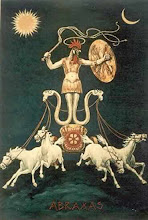
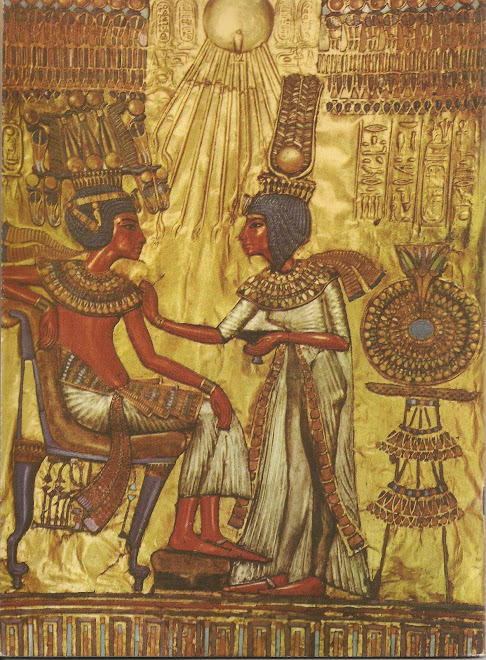
Pharaoh Akhenaten and his family adoring the Aten, second from the left is Meritaten who was the daughter of Akhenaten.

segunda-feira, 17 de setembro de 2012

O Mito de Sísifo - ensaio sobre o absurdo (Le Mythe de Sisyphe)


Info On The Books Subject From Wikipedia:


The Myth of Sisyphus is a philosophical essay by Albert Camus. It comprises about 120 pages and was published originally in 1942 in French as Le Mythe de Sisyphe; the English translation by Justin O'Brien followed in 1955.

In the essay, Camus introduces his philosophy of the absurd: man's futile search for meaning, unity, and clarity in the face of an unintelligible world devoid of God and eternal truths or values. Does the realization of the absurd require suicide? Camus answers: "No. It requires revolt." He then outlines several approaches to the absurd life. The final chapter compares the absurdity of man's life with the situation of Sisyphus, a figure of Greek mythology who was condemned to repeat forever the same meaningless task of pushing a boulder up a mountain, only to see it roll down again. The essay concludes, "The struggle itself [...] is enough to fill a man's heart. One must imagine Sisyphus happy."

The work can be seen in relation to other absurdist works by Camus: the novel The Stranger (1942), the plays The Misunderstanding (1942) and Caligula, and especially the essay The Rebel (1951).

Summary

The essay is dedicated to Pascal Pia and is organized in four chapters and one appendix.

Chapter 1: An Absurd Reasoning

Camus undertakes to answer what he considers to be the only question of philosophy that matters: Does the realization of the meaninglessness and absurdity of life necessarily require suicide?

He begins by describing the absurd condition: much of our life is built on the hope for tomorrow yet tomorrow brings us closer to death and is the ultimate enemy; people live as if they didn't know about the certainty of death; once stripped of its common romanticisms, the world is a foreign, strange and inhuman place; true knowledge is impossible and rationality and science cannot explain the world: their stories ultimately end in meaningless abstractions, in metaphors. "From the moment absurdity is recognized, it becomes a passion, the most harrowing of all."

It is not the world that is absurd, nor human thought: the absurd arises when the human need to understand meets the unreasonableness of the world, when "my appetite for the absolute and for unity" meets "the impossibility of reducing this world to a rational and reasonable principle."

He then characterizes a number of philosophies that describe and attempt to deal with this feeling of the absurd, by Heidegger, Jaspers, Shestov, Kierkegaard, and Husserl. All of these, he claims, commit "philosophical suicide" by reaching conclusions that contradict the original absurd position, either by abandoning reason and turning to God, as in the case of Kierkegaard and Shestov, or by elevating reason and ultimately arriving at ubiquitous Platonic forms and an abstract god, as in the case of Husserl.

For Camus, who set out to take the absurd seriously and follow it to its final conclusions, these "leaps" cannot convince. Taking the absurd seriously means acknowledging the contradiction between the desire of human reason and the unreasonable world. Suicide, then, also must be rejected: without man, the absurd cannot exist. The contradiction must be lived; reason and its limits must be acknowledged, without false hope. However, the absurd can never be accepted: it requires constant confrontation, constant revolt.

While the question of human freedom in the metaphysical sense loses interest to the absurd man, he gains freedom in a very concrete sense: no longer bound by hope for a better future or eternity, without a need to pursue life's purpose or to create meaning, "he enjoys a freedom with regard to common rules".

To embrace the absurd implies embracing all that the unreasonable world has to offer. Without a meaning in life, there is no scale of values. "What counts is not the best living but the most living."

Thus, Camus arrives at three consequences from the full acknowledging of the absurd: revolt, freedom and passion.

Chapter 2: The Absurd Man

How should the absurd man live? Clearly, no ethical rules apply, as they are all based on higher powers or on justification. "Integrity has no need of rules." 'Everything is permitted' "is not an outburst of relief or of joy, but rather a bitter acknowledgment of a fact."

Camus then goes on to present examples of the absurd life. He begins with Don Juan, the serial seducer who lives the passionate life to the fullest. "There is no noble love but that which recognizes itself to be both short-lived and exceptional."

The next example is the actor, who depicts ephemeral lives for ephemeral fame. "He demonstrates to what degree appearing creates being." "In those three hours he travels the whole course of the dead-end path that the man in the audience takes a lifetime to cover."

Camus' third example of the absurd man is the conqueror, the warrior who forgoes all promises of eternity to affect and engage fully in human history. He chooses action over contemplation, aware of the fact that nothing can last and no victory is final.

Chapter 3: Absurd Creation

Here Camus explores the absurd creator or artist. Since explanation is impossible, absurd art is restricted to a description of the myriad experiences in the world. "If the world were clear, art would not exist." Absurd creation, of course, also must refrain from judging and from alluding to even the slightest shadow of hope.

He then analyzes the work of Dostoyevsky in this light, especially The Diary of a Writer, The Possessed and The Brothers Karamazov. All these works start from the absurd position, and the first two explore the theme of philosophical suicide. But both The Diary and his last novel, The Brothers Karamazov, ultimately find a path to hope and faith and thus fail as truly absurd creations.

Chapter 4: The Myth of Sisyphus

In the last chapter, Camus outlines the legend of Sisyphus who defied the gods and put Death in chains so that no human needed to die. When Death was eventually liberated and it came time for Sisyphus himself to die, he concocted a deceit which let him escape from the underworld. Finally captured, the gods decided on his punishment: for all eternity, he would have to push a rock up a mountain; upon reaching the top, the rock would roll down again leaving Sisyphus to start over. Camus sees Sisyphus as the absurd hero who lives life to the fullest, hates death and is condemned to a meaningless task.

Camus presents Sisyphus's ceaseless and pointless toil as a metaphor for modern lives spent working at futile jobs in factories and offices. "The workman of today works every day in his life at the same tasks, and this fate is no less absurd. But it is tragic only at the rare moments when it becomes conscious."

Camus is interested in Sisyphus' thoughts when marching down the mountain, to start anew. This is the truly tragic moment, when the hero becomes conscious of his wretched condition. He does not have hope, but "[t]here is no fate that cannot be surmounted by scorn." Acknowledging the truth will conquer it; Sisyphus, just like the absurd man, keeps pushing. Camus claims that when Sisyphus acknowledges the futility of his task and the certainty of his fate, he is freed to realize the absurdity of his situation and to reach a state of contented acceptance. With a nod to the similarly cursed Greek hero Oedipus, Camus concludes that "all is well," indeed, that "[o]ne must imagine Sisyphus happy."

Appendix

The essay contains an appendix titled "Hope and the Absurd in the work of Franz Kafka". While Camus acknowledges that Kafka's work represents an exquisite description of the absurd condition, he maintains that Kafka fails as an absurd writer because his work retains a glimmer of hope.


( http://en.wikipedia.org/wiki/The_Myth_of_Sisyphus )

( http://www.livrosdobrasil.com/livro_detail.php?ART_ID=1085 )

( http://www.livrosdobrasil.com/livro_detail.php?ART_ID=2546 )


Sisyphus by Titian, 1549

O Homem Revoltado (L'Homme Révolté)


Info On The Books Subject From Wikipedia:

The Rebel (French title: L'Homme révolté) is a 1951 book-length essay by Albert Camus, which treats both the metaphysical and the historical development of rebellion and revolution in societies, especially Western Europe. Camus relates writers and artists as diverse as Epicurus and Lucretius, the Marquis de Sade, Georg Wilhelm Friedrich Hegel, Fyodor Dostoyevsky, Friedrich Nietzsche, Max Stirner, André Breton and others in an integrated, historical portrait of man in revolt. Examining both rebellion and revolt, which may be seen as the same phenomenon in personal and social frames, Camus examines several 'countercultural' figures and movements from the history of western thought and art, noting the importance of each in the overall development of revolutionary thought and philosophy.

Themes

One of Camus' primary arguments in The Rebel concerns the motivation for rebellion and revolution. While the two acts - which can be interpreted from Camus' writing as states of being - are radically different in most respects, they both stem from a basic human rejection of normative justice. If human beings become disenchanted with contemporary applications of justice, Camus suggests that they rebel. This rebellion, then, is the product of a basic contradiction between the human mind's unceasing quest for clarification and the apparently meaningless nature of the world. Described by Camus as "absurd", this latter perception must be examined with what Camus terms "lucidity." Camus concludes that the absurd sensibility contradicts itself because when it claims to believe in nothing, it believes in its own protest and the value of the protester's life. Therefore, this sensibility is logically a "point of departure" that irresistibly "exceeds itself." In the inborn impulse to rebel, on the other hand, we can deduce values that enable us to determine that murder and oppression are illegitimate and conclude with "hope for a new creation."

Another prominent theme in The Rebel, which is tied to the notion of incipient rebellion, is the inevitable failure of attempts at human perfection. Through an examination of various titular revolutions, and in particular the French Revolution, Camus argues that most revolution has involved a fundamental denial of both history and transcendental values. Such revolutionaries aimed to kill God. In the French Revolution, for instance, this was achieved through the execution of Louis XVI and subsequent eradication of the Divine Right of Kings. The subsequent rise of Utopian and materialist idealism sought "the end of history." Because this end is unattainable, according to Camus, terror ensued as the revolutionaries attempted to coerce results. This culminated in the "temporary" enslaving of people in the name of their future liberation. Notably, Camus' reliance on non-secular sentiment does not involve a defence of religion; indeed, the replacement of divinely-justified morality with pragmatism simply represents Camus' apotheosis of transcendental, moral values.

Faced with the manifest injustices of human existence on one hand, and the poor substitute of revolution on the other, Camus' rebel seeks to fight for justice without abandoning transcendental values, including the principle of the intrinsic value of human life. Consequently, some rebels attempt to justify their actions through a crude form of payment. As Camus argues, the Russian terrorists active in the early 20th century were prepared to offer their own lives as payment for the lives they took.

A third is that of crime, as Camus discusses how rebels who get carried away lose touch with the original basis of their rebellion and offer various defenses of crime through various historical epochs.

At the end of this book Camus exposes the possible moral superiority of the ethics and political plan of syndicalism.


( http://en.wikipedia.org/wiki/The_Rebel_(book) )


( http://www.livrosdobrasil.com/livro_detail.php?ART_ID=2401 )


Vintage International's 1991 reissue of Anthony Bower's translation of The Rebel.
 

segunda-feira, 3 de setembro de 2012

Revista Portuguesa de Filosofia, Tomo LVII - Fascículo 3 (2001)


( http://www.rpf.pt/index.php?option=com_sobipro&pid=54&sid=70:Desafios-do-Mal-Do-Misterio-a-Sabedoria&Itemid=0&lang=pt )

( http://www.facfil.ucp.pt/rpf/rpf.htm )


InfoLinks Related to the Content of the Book:
http://en.wikipedia.org/wiki/Problem_of_evil
http://en.wikipedia.org/wiki/Evil
http://en.wikipedia.org/wiki/Moral_evil
http://en.wikipedia.org/wiki/Injustice
http://en.wikipedia.org/wiki/Violence
http://en.wikipedia.org/wiki/Pain
http://en.wikipedia.org/wiki/T._S._Eliot
http://en.wikipedia.org/wiki/Sublime_(philosophy)

Revista Portuguesa de Filosofia, Tomo LVII - Fascículos 1 & 2 (2001)


( http://www.rpf.pt/index.php?option=com_sobipro&pid=54&sid=68:Friedrich-Nietzsche-1844-1900-I-Efeitos-do-seu-Pensamento&Itemid=0&lang=pt )


( http://www.rpf.pt/index.php?option=com_sobipro&pid=54&sid=69:Friedrich-Nietzsche-1844-1900-II-Aspectos-do-seu-Pensamento&Itemid=0&lang=pt )


Info On The Book's Publisher:

Published by the Department of Philosophy of the Faculdade de Filosofia de Braga at the Catholic University of Portugal, the Revista Portuguesa de Filosofia is a periodic publication appearing four times a year with Portuguese as its official language. It is, however, open to the possibility of publishing original texts in other European languages (e.g., English, French, German, Spanish, Italian, Galician, or Catalan), having as a policy that at least 50% of its texts be in Portuguese. Although identified with the Christian tradition, the Revista Portuguesa de Filosofia welcomes in its pages a plurality of philosophical perspectives, its only requirement being that the work to be published be of superior quality, reveal scholarly integrity, and observe the recommended methodological guidelines for the formal and scientific presentation of texts. The articles to be published in the Revista Portuguesa de Filosofia may be either solicited or submitted. Once published the articles are usually indexed by the following data bases and bibliographic repertoires: The Philosophier's Index (Ohio, USA); International Philosophical Bibliography / Répertoire Bibliographique de la Philosophie (Louvain, Belgique); Francis-Builletin Signalétique (CNRS, INIST-France); Ulrich's International Periodicals Directory (New York, USA); Internationale Bibliographie Geistes und Sozialwissenschaftlicher Zeitschriftenliteratur (IBZ-Alemanha).


Source: http://www.facfil.ucp.pt/rpf/rpf.htm

Nietzsche (Gilles Deleuze)


EDIÇÕES 70, Um breve historial

Como o seu nome indica, Edições 70 nasce com o início da década de 70, que se anunciava portadora de profundas mudanças. Por isso, merecem destaque os seus primeiros quatro anos, até 25 de Abril de 1974, aqueles em que a editora viu mais ameaçada as suas possibilidades de sobrevivência, pela apertada vigilância exercida pela Censura; de facto, durante esse período foram muitas as proibições e apreensões de diversas obras, o que, além de outros riscos, significava perdas financeiras irreparáveis.

A nova dinâmica histórica que se implantou em Portugal, consagrando princípios de liberdade política, permitiu a criação de projectos novos mais ambiciosos, que se puderam concretizar nos anos sucessivos.

Assim, em 1976, Edições 70 iniciou um processo de intensa cooperação com os responsáveis culturais dos novos países africanos de expressão portuguesa (em especial de Angola e Moçambique), que permitiu, no espaço de uma década, a divulgação de muitas obras e autores representativos desses países.

A partir de 1978, edições 70 deu início a um trabalho de maior alcance, com o lançamento simultâneo de várias colecções, que ainda hoje constituem a «imagem de marca» da editora, através das quais consagrou a sua afirmação vocacional no âmbito das ciências humanas; de facto, são dessa altura colecções com a ambição de «O Lugar da História», «Perspectivas do Homem», «Arte & Comunicação», «Biblioteca Básica de Filosofia», «Textos Filosóficos», entre outras.

Nas muitas centenas de obras publicadas ao longo de quase quatro décadas, cuja parte mais importante constitui hoje o fundo de catálogo de Edições 70, é patente a opção pela edição de Cultura, no mais amplo e nobre sentido da palavra.

É no campo das Ciências Humanas e Sociais que mais vincada se encontra a filosofia da nossa acção editorial: na realidade, do ensaio à historiografia, da investigação antropológica à divulgação do saber científico, da problemática actual na arquitectura e no urbanismo ao ensaio sobre arte, da música à filosofia até ao pensamento da antiguidade clássica, oferecemos ao público de Língua Portuguesa um vasto repositório de títulos que, pelo rigor no seu tratamento, homogeneidade interdisciplinar e oportunidade temática, não tem paralelo na edição nacional.

Em 2005, Edições 70 juntou-se ao Grupo Almedina, alargando a sua influência e complementando o rigor das suas propostas editoriais, que se reflectem na homogénea articulação interdisciplinar do seu catálogo, podendo, como há mais de três décadas, reivindicar o seu lema de sempre: «Por uma cultura viva e livre».


Fonte: http://www.edicoes70.pt/site/node/5

( http://www.edicoes70.pt/site/node/3?id=4047 )


InfoLinks Related to the Content of the Book:
http://en.wikipedia.org/wiki/Friedrich_Nietzsche#Apollonian_and_Dionysian
http://en.wikipedia.org/wiki/Friedrich_Nietzsche#Will_to_power
http://en.wikipedia.org/wiki/Friedrich_Nietzsche#Death_of_God_and_Nihilism
http://en.wikipedia.org/wiki/Friedrich_Nietzsche#.C3.9Cbermensch
http://en.wikipedia.org/wiki/Friedrich_Nietzsche#Eternal_return

http://en.wikipedia.org/wiki/Gilles_Deleuze
http://en.wikipedia.org/wiki/Friedrich_Nietzsche

dossiê especial Nietzsche - RESSENTIMENTO, RESISTÊNCIA, O BELO E A DIMENSÃO ARTÍSTICA DA VIDA, SEGUNDO O PENSADOR (Filosofia Ciência & Vida nº 19 Brasil - nº 08 Portugal)


( http://filosofiacienciaevida.uol.com.br/ESFI/edicoes/19/sumario.asp )

( http://www.escala.com.br/ )

segunda-feira, 9 de julho de 2012

OVNIs - Los documentos sonoros definitivos


More Info Here:
http://www.ivoox.com/mas-alla-ovnis-documentos-sonoros-definitivos-audios-mp3_rf_251622_1.html
http://www.audiolibrogratis.com/2010/08/ovnis-los-documentos-sonoros.html
http://es-la.facebook.com/note.php?note_id=152325424777994
http://english.javiersierra.com/biography.php

Philadelphia Experiment

The Philadelphia Experiment is the name of a naval military experiment alleged to have been carried out at the Philadelphia Naval Shipyard in Philadelphia, Pennsylvania, USA sometime around October 28, 1943. It is alleged that the U.S. Navy destroyer escort USS Eldridge was to be rendered invisible (or "cloaked") to enemy devices. The experiment is also referred to as Project Rainbow.

The story is widely regarded as a hoax.[1][2][3] The U.S. Navy maintains that no such experiment occurred, and details of the story contradict well-established facts about the Eldridge, as well as the known laws of physics.[4] The story has captured imaginations of people in conspiracy theory circles, and they repeat elements of the Philadelphia Experiment in other government conspiracy theories.

Contents

1 Synopsis
2 Origins of the story
2.1 Morris Jessup and Carlos Miguel Allende
2.2 The Office of Naval Research and the Varo annotation
3 Repetitions of the story
3.1 Hollywood interpretation and the Bielek testimony
4 Evidence
4.1 Evidence and research
4.2 Scientific aspects
4.3 Timeline inconsistencies
4.4 Alternative explanations
5 Cultural references
6 See also
7 Notes
8 References
9 External links

Synopsis

Note: Several different and sometimes contradictory versions of the alleged experiment have circulated over the years. The following synopsis illustrates key story points common to most accounts.[2]

The experiment was allegedly based on an aspect of the unified field theory, a term coined by Albert Einstein. The Unified Field Theory aims to describe mathematically and physically the interrelated nature of the forces that comprise electromagnetic radiation and gravity, although to date, no single theory has successfully expressed these relationships in viable mathematical or physical terms.

According to the accounts, researchers thought that some version of this Unified Field Theory would enable the Navy to use large electrical generators to bend light around an object so that it became completely invisible. The Navy would have regarded this as being of obvious military value, and by the accounts, it sponsored the experiment.

Another version of the story proposes that researchers were preparing magnetic and gravitational measurements of the seafloor to detect anomalies, supposedly based on Einstein's attempts to understand gravity. In this version there were also related secret experiments in Nazi Germany to find antigravity, allegedly led by SS-Obergruppenführer Hans Kammler.

In most accounts of the experiment, the destroyer escort USS Eldridge was fitted with the required equipment at the Philadelphia Naval Yard. Testing began in the summer of 1943, and it was supposedly successful to a limited degree. One test, on July 22, 1943, resulted in the Eldridge being rendered almost completely invisible, with some witnesses reporting a "greenish fog" appearing in its place. Crew members supposedly complained of severe nausea afterwards. Also, it is said that when the ship reappeared, some sailors were embedded in the metal structures of the ship, including one sailor who ended up on a deck level below that where he began, and had his hand embedded in the steel hull of the ship.[5] At that point, it is said that the experiment was altered at the request of the Navy, with the new objective being solely to render the Eldridge invisible to radar. None of these allegations has been independently substantiated.

The conjecture then alleges that the equipment was not properly re-calibrated, but in spite of this, the experiment was repeated on October 28, 1943. This time, the Eldridge not only became invisible, but she physically vanished from the area in a flash of blue light and teleported to Norfolk, Virginia, over 200 miles (320 km) away. It is claimed that the Eldridge sat for some time in full view of men aboard the ship SS Andrew Furuseth, whereupon the Eldridge vanished from their sight, and then reappeared in Philadelphia at the site it had originally occupied. It was also said that the warship traveled back in time for about 10 seconds.

Many versions of the tale include descriptions of serious side effects for the crew. Some crew members were said to have been physically fused to bulkheads, while others suffered from mental disorders, and still others supposedly simply vanished. It is also claimed that the ship's crew may have been subjected to brainwashing, in order to maintain the secrecy of the experiment.

Origins of the story

Morris Jessup and Carlos Miguel Allende

In 1955, Morris K. Jessup, an astronomer and former graduate-level researcher, published The Case for the UFO, a book about unidentified flying objects that contains some theories about the different means of propulsion that flying-saucer-style UFOs might use. Jessup speculated that antigravity or the manipulation of electromagnetism may be responsible for the observed flight behavior of UFOs. He lamented, both in the book and during the publicity tour that followed, that space flight research was concentrated in the area of rocketry, and that little attention had been paid to other theoretical means of flight, which he felt might ultimately be more fruitful. Jessup emphasized that a breakthrough revision of Albert Einstein's "Unified Field Theory" would be critical in powering a future generation of spacecraft.

On January 13, 1955, Jessup received a letter from a man who identified himself as one "Carlos Allende". In the letter, Allende informed Jessup of the "Philadelphia Experiment", alluding to two poorly sourced contemporary newspaper articles as proof. Allende directly responded to Jessup's call for research on the "Unified Field Theory", which he referred to as "UFT". According to Allende, Einstein had solved the theory, but had suppressed it, since mankind was not ready for it—a confession that the scientist allegedly shared with the mathematician and philosopher Bertrand Russell. Allende also said that he had witnessed the Eldridge appear and disappear while serving aboard the SS Andrew Furuseth, a nearby merchant ship. Allende named other crew members with whom he served aboard the Andrew Furuseth, and claimed to know the fate of some of the crew members of the Eldridge after the experiment, including one whom he witnessed disappearing during a chaotic fight in a bar. Although Allende claimed to have observed the experiment while on the Andrew Furuseth, he provided no substantiation of his other claims linking the experiment with the Unified Field Theory, no evidence of Einstein's alleged resolution of the theory, and no proof of Einstein's alleged private confession to Russell.

Jessup replied to Allende by a postcard, asking for further evidence and corroboration. The reply arrived months later, with the correspondent identifying himself as "Carl M. Allen". Allen said that he could not provide the details for which Jessup was asking, but he implied that he might be able to recall some by means of hypnosis. Suspecting that Allende/Allen was a fraud, Jessup discontinued the correspondence.

The Office of Naval Research and the Varo annotation

According to a 2002 book by the popular writers James Moseley and Karl Pflock, in early 1957, Jessup was contacted by the Office of Naval Research (ONR) in Washington, D.C., and was asked to study the contents of a parcel that it had received.[6] Upon his arrival, Jessup was surprised to learn that a paperback copy of his UFO book had been mailed to the ONR in a manila envelope marked "Happy Easter." The book had been extensively annotated in its margins, and an ONR officer asked Jessup if he had any idea as to who had done so.

Moseley and Pflock claim that the lengthy annotations were written with three different shades of pink ink, and they appeared to detail a correspondence among three individuals, only one of which is given a name: "Jemi". The ONR labelled the other two "Mr A." and "Mr B." The annotators refer to each other as "Gypsies," and discuss two different types of "people" living in outer space. Their text contained non-standard use of capitalization and punctuation, and detailed a lengthy discussion of the merits of various elements of Jessup's assumptions in the book. Their oblique references to the Philadelphia Experiment suggested prior or superior knowledge (for example, "Mr B." reassures his fellow annotators who have highlighted a certain theory of Jessup’s).[6]

Based on the handwriting style and subject matter, Jessup identified "Mr A." as Allende / Allen. Others have suggested that the three annotations are from the same person, using three pens.[citation needed] The annotated book supposedly sparked sufficient interest for the ONR to fund a small printing of the volume by the Texas-based Varo Manufacturing Company.[7] A 2003 transcription of the annotated "Varo edition" is available online, complete with three-color notes.[8]

Later, the ONR contacted Jessup, claiming that the return address on Allende's letter to Jessup was an abandoned farmhouse. They also informed Jessup that the Varo Corporation, a research firm, was preparing a print copy of the annotated version of The Case for the UFO, complete with both letters he had received. About a hundred copies of the Varo Edition were printed and distributed within the Navy. Jessup was also sent three for his own use.

Jessup attempted to make a living writing on the topic, but his follow-up book did not sell well. His publisher rejected several other manuscripts. In 1958, his wife left him, and his friends described him as being depressed and somewhat unstable when he traveled to New York. After returning to Florida, he was involved in a serious car accident and was slow to recover, which added to his depression. He was found dead on April 20, 1959, and the death was ruled a suicide.[citation needed]

Repetitions of the story

There have been non-fiction and fictional accounts of the legend:

In 1963, Vincent Gaddis published a book of Forteana entitled Invisible Horizons: True Mysteries of the Sea. In it he recounted the story of the experiment from the Varo annotation.

George E. Simpson and Neal R. Burger published a 1978 novel entitled Thin Air. In this book, set in the present day, a Naval Investigative Service officer investigates several threads linking wartime invisibility experiments to a conspiracy involving matter transmission technology.

In 1979 Charles Berlitz and his co-author ufologist William L. Moore published The Philadelphia Experiment: Project Invisibility, which purported to be a factual account.

More recently, Simon R. Green included references to "The Philadelphia Experiment" in his book The Spy Who Haunted Me, while Paul Violette's book Secrets of Anti-Gravity Propulsion recounts some mysterious involvement of the physicist Thomas Townsend Brown of the Philadelphia Navy yard.

Hollywood interpretation and the Bielek testimony

In 1984, the story was adapted into a time travel film called The Philadelphia Experiment directed by Stewart Raffill. Though only loosely based on the prior accounts of the "Experiment", it served to dramatize the core elements of the original story. In 1990, Alfred Bielek,[9][10] a self-proclaimed former crew-member of the USS Eldridge and an alleged witness of the "Experiment", supported the version as it was portrayed in the film. He added details of his claims through the Internet, some of which were picked up by mainstream outlets.[11]

In 2003, a small team of investigators, including the American Marshall Barnes, the Canadian Fred Houpt, and the German Gerold Schelm, rejected Bielek's story of his participation in "The Philadelphia Experiment". Their consensus was that Bielek was nowhere near the ship at the proposed time of the experiment.[11]

The horror/action movie Outpost, in which the Nazi Germans were supposedly conducting similar tests on soldiers, has a reference to the "Philadelphia Experiment".

The 2008 science fiction 100 Million BC has a clear reference to "The Philadelphia Experiment" or "The Rainbow Project".[12]

Evidence

Research into the supposed experiment has revealed many contradictions and inconsistencies in the accounts. No scientific support for the described phenomena or the purported events has surfaced.

Evidence and research

Many observers argue that it is inappropriate to grant much credence to an unusual story promoted by one individual, in the absence of more conclusive corroborating evidence. Robert Goerman wrote in Fate magazine in 1980, that "Carlos Allende" / "Carl Allen" was Carl Meredith Allen of New Kensington, Pennsylvania, who had an established history of psychiatric illness, and who may have fabricated the primary history of the experiment as a result of his mental illness. Goerman later realized that Allen was a family friend and "a creative and imaginative loner... sending bizarre writings and claims."[13]

The historian Mike Dash[2] notes that many authors who publicized the "Philadelphia Experiment" story after that of Jessup appeared to have conducted little or no research of their own: through the late 1970s, for example, Allende/Allen was often described as mysterious and difficult to locate. But Goerman determined Allende/Allen's identity after only a few telephone calls. Others speculate that much of the key literature emphasizes dramatic embellishment rather than pertinent research. Berlitz and Moore's account of the story (The Philadelphia Experiment: Project Invisibility) claimed to include supposedly factual information, such as transcripts of an interview with a scientist involved in the experiment, their work has also been criticized for plagiarising key story elements from the novel Thin Air which was published a year earlier.

Scientific aspects

The claims of "The Philadelphia Experiment" contradict the known laws of physics. Magnetic fields cannot bend light waves according to Maxwell's equations. While Einstein's theory of general relativity shows that light waves can be bent near the surface of an extremely massive object, such as the sun or a black hole, current technology cannot manipulate the astronomical amounts of matter needed to do this.

No Unified Field Theory exists, although it is a subject of ongoing research. William Moore claimed in his book on "The Philadelphia Experiment" that Albert Einstein completed, and destroyed, a theory before his death. This is not supported by historians and scientists familiar with Einstein's work. Moore bases his theory on Carl Allen's letter to Jessup, in which Allen refers to a conversation between Einstein and Bertrand Russell acknowledging that the theory had been solved, but that man was not ready for it.[14]

Shortly before his death in 1943, the Serbian-American inventor and engineer Nikola Tesla was said to have completed some kind of a "Unified Field Theory". It was never published.[15]

The 2006 movie "The Prestige" makes reference to this claim with a device powered by a large Tesla coil that is created by Tesla himself, to make things disappear, but instead creates an exact replica that comes into being a short distance away.

These claims are completely at odds with modern physics. While it is true that Einstein attempted to unify gravity with electromagnetism based on classical physics, his geometric approaches, called classical unified field theories, ignored the modern developments of quantum theory and the discovery of the strong nuclear force and weak nuclear force. Most physicists consider his overall approach to be unsuccessful. Attempts by recent scientists to develop a unified theory focus on the development of a quantum theory that includes gravitation.

While very limited "invisibility cloaks" have recently been developed using metamaterial,[16] these are unrelated to theories linking electromagnetism with gravity.

Timeline inconsistencies

The USS Eldridge was not commissioned until August 27, 1943, and it remained in port in New York City until September 1943. The October experiment allegedly took place while the ship was on its first shakedown cruise in the Bahamas, although proponents of the story claim that the ship's logs might have been falsified, or else still be classified.

The Office of Naval Research (ONR) stated in September 1996, "ONR has never conducted investigations on radar invisibility, either in 1943 or at any other time". Pointing out that the ONR was not established until 1946, it denounces the accounts of "The Philadelphia Experiment" as complete "science fiction".

A reunion of navy veterans who had served aboard the USS Eldridge told a Philadelphia newspaper in April 1999 that their ship had never made port in Philadelphia.[17] Further evidence discounting the Philadelphia Experiment timeline comes from the USS Eldridge’s complete World War II action report, including the remarks section of the 1943 deck log, available on microfilm.[4]

Alternative explanations

Researcher Jacques Vallée[18] describes a procedure on board the USS Engstrom (DE-50), which was docked alongside the Eldridge in 1943. The operation involved the generation of a powerful electromagnetic field on board the ship in order to deperm or degauss it, with the goal of rendering the ship undetectable or "invisible" to magnetically-fused undersea mines and torpedoes. This system was invented by a Canadian, and the Royal Navy and other navies used it widely during WWII. British ships of the era often included such degaussing systems built into the upper decks (the conduits are still visible on the deck of HMS Belfast (C35) in London, for example). Degaussing is still used today. However, it has absolutely no effect on visible light or radar. Vallée speculates that accounts of the USS Engstrom’s degaussing might have been garbled and confabulated in subsequent retellings, and that these accounts may have influenced the story of "The Philadelphia Experiment".

According to Vallée, a Navy veteran who served on board the USS Engstrom noted that the Eldridge might indeed have travelled from Philadelphia to Norfolk and back again in a single day at a time when merchant ships could not: by use of the Chesapeake and Delaware Canal and the Chesapeake Bay, which at the time was open only to naval vessels.[18] Use of that channel was kept quiet: German submarines had ravaged shipping along the East Coast during Operation Drumbeat, and thus military ships unable to protect themselves were secretly moved via canals to avoid the threat.[19] This same veteran claims to be the man that Allende witnessed “disappearing” at a bar. He claims that when the fight broke out, friendly barmaids whisked him out the back door of the bar before the police arrived, because he was under age for drinking. They then covered for him by claiming that he had disappeared.[19]

Cultural references

The Half Life video game series' story of the Borealis seems to be based on the story of "The Philadelphia Experiment".

Brief references to the experiment may be found in the Bioshock 2 viral website "There's Something in the Sea".

The computer game Command & Conquer: Red Alert references this in a video regarding the Allied Chronosphere, in which footage is shown of a ship disappearing then reappearing seconds later. One of the commanders remarks that some of the men on board died and the process is still experimental.

The experiment has been the subject of several television shows dealing with the paranormal and with conspiracy theories, including The Unexplained, History's Mysteries, Vanishings!, Unsolved Mysteries,[20] and Dark Matters: Twisted But True.

It has been used in film and literature to explain time travel and non-linear plots, such as in William S. Burroughs novel Cities of the Red Night or the movie 100 Million BC.

References to the experiment can be found in many other works, including an episode of The X-Files entitled "Død Kalm", Sanctuary, The Triangle, the Doctor Who audio drama The Macros, the collaborative science-fiction novella Green Fire[21], and the novels The Spy who Haunted Me, Ship of the Damned, and Retromancer.

The "Experiment" is also referenced again in the fourth Doctor Who:The Adventure Games release, "Shadows of the Vashta Nerada".

The date and name of "The Philadelphia Experiment" are referred to in the first game of the video game series Assassin's Creed. The password to access the conference room is "10281943" (the proposed date in American format) and an email also refers to the "project". An email to one of the characters in the game mentions that the ship, instead of turning invisible, "briefly manifested in a future state for approximately 18 minutes." The same email also says that the fictional company that engineered the project, Abstergo Industries, chose to drop the project, "citing paradox concerns."

The ship's barometer from the Eldridge is an Artifact on the Syfy show Warehouse 13. Activating it freezes time in a localized area for forty-seven seconds, with the person who activated it being unaffected.

"The Philadelphia Experiment" is referenced in Brad Thor's The Athena Project. The novel suggests that the US Navy was trying to recreate matter teleportation experiments originally conducted by Hans Kammler and the Nazi SS Wunderwaffen group.

See also

Andrew Furuseth, namesake of the S.S. Andrew Furuseth
http://en.wikipedia.org/wiki/Andrew_Furuseth
Morris K. Jessup
http://en.wikipedia.org/wiki/Morris_K._Jessup
Camp Hero
http://en.wikipedia.org/wiki/Camp_Hero
List of conspiracy theories
http://en.wikipedia.org/wiki/List_of_conspiracy_theories

Notes
 
1.^ Carroll, Robert Todd (2007-12-03). "Philadelphia experiment". The Skeptic's Dictionary. http://skepdic.com/philadel.html. Retrieved 2008-02-05.

2.^ a b c Dash, Mike (2000) [1997]. Borderlands. Woodstock, New York: Overlook Press. ISBN 978-0-87951-724-3. OCLC 41932447.

3.^ Adams, Cecil (1987-10-23). "Did the U.S. Navy teleport ships in the Philadelphia Experiment?". The Straight Dope. http://www.straightdope.com/classics/a2_293.html. Retrieved 2007-02-20.

4.^ a b "The "Philadelphia Experiment"". Naval Historical Center of the United States Navy. 2000-11-28. http://www.history.navy.mil/faqs/faq21-1.htm. Retrieved 2007-02-20.

5.^ History Channel : That's Impossible!

6.^ a b Moseley, James W. & Karl T. Pflock (2002), Shockingly Close to the Truth!: Confessions of a Grave-Robbing Ufologist, Prometheus Books, ISBN 1-57392-991-3

7.^ Introduction to the Varo edition of M. K. Jessup's Case for the UFO

8.^ Jessup, M. K. (2003) [1973] (pdf). "Varo Edition" — The Case for the Unidentified Flying Object. The Cassiopaean Experiment. http://www.cassiopaea.org/cass/Varo-Jessup.pdf.

9.^ Death of Al Bielek announced on Coast to Coast AM broadcast by George Noory on 13 October 2011

10.^ Al Bielek (March 31, 1927 – October 10, 2011) dies in Guadalajara, Mexico, age 84. http://educate-yourself.org/ab/albielekpasses14oct11.shtml

11.^ a b "Al Bielek Debunked". 2008-01-14. http://www.bielek-debunked.com.

12.^ http://www.imdb.com/title/tt1136683/

13.^ Brian Dunning (2006-12-24). "The Real Philadelphia Experiment: Did a US Navy warship completely disappear in 1943?". Skeptoid: Critical Analysis of Pop Phenomena. http://skeptoid.com/episodes/4016. Retrieved 2011-12-12.

14.^ The Philadelphia Experiment: Project Invisibility, William L. Moore, Grosset and Dunlap, New York, New York, 1979, pages 18-19.

15.^ "Prepared Statement by Nikola Tesla" (.doc file). Pepe's Tesla Pages. 1889. http://www.tesla.hu/tesla/articles/19370710.doc.

16.^ See, for example here and here.

17.^ Lewis, Frank (August 19–26, 1999). "The Where Ship? Project: Though long dismissed by the Navy, the legend of The Philadelphia Experiment shows no signs of disappearing". Philadelphia City Paper. http://citypaper.net/articles/081999/news.cb.ship.shtml. Retrieved 2008-02-05.

18.^ a b Vallée, Jacques F. (1994) "Anatomy of a Hoax: The Philadelphia Experiment Fifty Years Later" Journal of Scientific Exploration Vol 8 No 1 pg 47-71

19.^ a b abstract of "Anatomy of a Hoax: The Philadelphia Experiment Fifty Years Later" by Jacques F. Vallee, URL accessed February 21, 2007

20.^ TV.com: Philadelphia Experiment, Unsolved Mysteries aired 1/1/06, Dark Matters aired 8//31/11, 10/31/11

21.^ "Green Fire" by Eileen Gunn, Andy Duncan (writer), Pat Murphy (writer), and Michael Swanwick. First published on the Event Horizon website, December, 1998-January 1999. Reprinted in Asimov's Science Fiction Magazine, April, 2000, and in book form in Stable Strategies and Others (Tachyon Publications, 2004).

References
 
Farrell, Joseph P. (2008). Secrets of the Unified Field: The Philadelphia Experiment, The Nazi Bell, and the Discarded Theory. Adventures Unlimited Press. ISBN 1-931882-84-3.
 
External links
 
The Philadelphia Experiment from A-Z

History of the Eldridge

Science Article about High Tech Materials that can funnel light around an object

"Experts test cloaking technology". BBC News. 2006-10-19. http://news.bbc.co.uk/2/hi/science/nature/6064620.stm. Retrieved 2008-08-05. using Metamaterials

Link catalogue for the Philadelphia Experiment and the Montauk Project

Site debunking the claims of one Alfred Bielek, allegedly an eyewitness and survivor of the Philadelphia Experiment

Naval Historical Center's entry for the "Philadelphia Experiment"

Navweaps.com entry for the "Philadelphia Experiment"

Skeptic's Dictionary entry for the "Philadelphia Experiment"

The Philadelphia Experiment at the Internet Movie Database

100 Million BC at the Internet Movie Database

The UFO and the Sailor

Robert Goerman's Alias Carlos Allende: The Mystery Man Behind the Philadelphia Experiment

Joe Turner's The Philadelphia Experiment: What They Don't Want You to Know

Straight Dope on the Philadelphia Experiment

 
Wikipedia Source Link: http://en.wikipedia.org/wiki/Philadelphia_Experiment
 
Related Article (in portuguese...): http://pt.scribd.com/doc/88294499/Casos-Extraordinarios-A-Experiencia-de-Filadelfia


Os Mensageiros do Cosmo (Les Messagers du Cosmos)


( http://www.europa-america.pt/product_info.php?products_id=4586 )

( http://www.amazon.com/messagers-cosmos-Enigmes-lunivers-Edition/dp/2221005619 )

( http://www.imdb.com/name/nm1132043/bio )


quarta-feira, 20 de junho de 2012

Sacerdotes ou Astronautas? (¿Sacerdotes o Cosmonautas?)


Info On Andreas Faber-Kaiser (in spanish...):

Andreas Faber-Kaiser (Barcelona, 5 de abril de 1944 - ibídem, 14 de marzo de 1994) fue un ufólogo y escritor germano-español especializado en la investigación de los aspectos misteriosos y ocultos de nuestra historia, sobre todo en la relación existente de los dioses de la antigüedad con los actuales ovnis, habiendo participado como ponente en numerosos congresos internacionales dedicados a este tipo de temáticas, tanto en Europa como en América.

Biografía

Nació en Barcelona el 5 de abril de 1944, se licenció en Filosofía y letras, obteniendo en 1972 el Premio Nacional de Astronáutica «Julio Marial» por su estudio Repercusión de la astronáutica en la vida del hombre. En 1976 fundó la revista Mundo Desconocido[1] en colaboración con el también desaparecido periodista e investigador argentino Alejandro Vignati, considerada en su momento a nivel mundial como una de las tres primeras publicaciones en su género, y galardonada en 1980 con el premio «Secinter» a la mejor revista especializada. Dejó de publicarse en noviembre de 1982, si bién siguió operando desde entonces como red de investigación internacional, financiando diversos estudios. En verano de 1988 presentó en Catalunya Ràdio el programa ¿Què volen aquesta gent?[2] (¿Que quiere esta gente?), un programa dedicado al mundo de los ovnis. Desde su fundación en 1989 y hasta mayo de 1992 fue Consejero Editorial y Coordinador Internacional de la revista Más Allá de la Ciencia, revista publicada por MC Ediciones y dedicada al mundo del misterio, del esoterismo y la ufología, asimismo también fue Consejero Editorial de JC Ediciones S.A. De 1988 a 1994 dirigió y presentó en Catalunya Ràdio el programa Sintonia Alfa,[2] espacio centrado en temas ufológicos y misteriosos, alternándolo con el programa especial Arxiu Secret[2] (Archivo Secreto).

En agosto de 1992 abrió como primer ponente el Curso Especializado en Extensión Cultural : “Grandes Enigmas: Los Ovnis”, organizado por la Universidad Complutense de Madrid dentro de sus Cursos de Verano y dirigido por J. J. Benítez, constituyendo el primer curso de ufología celebrado en una universidad española.

Sus viajes de investigación le llevaron a buena parte de Europa, Asia, América y Oceanía, consecuencia de ellos son la publicación de algunos de sus libros, como el pólemico Jesús vivió y murió en Cachemira (1976). Un libro donde exponía la posibilidad de que Jesús de Nazaret no hubiera muerto en la cruz, sino que una vez curado de sus graves heridas causadas durante la crucifixión huyera hacia el este en busca de las tribus perdidas de Israel y una vez en Cachemira hubiera comenzado una nueva vida muriendo a un edad muy avanzada de muerte natural.

No menos controvertido fue su libro Pacto de silencio (1988), un libro sobre el Síndrome tóxico, una enfermedad aparecida en 1981 y causada oficialmente por el consumo de aceite de colza desnaturalizado[n. 1] ,consecuencia del fraude alimenticio realizado por unos comerciantes aceiteros, que lo distribuían en venta ambulante como aceite de oliva[n. 2] ,causando 1.100 muertos[n. 3] y más de 60.000 afectados. En este libro intenta demostrar que la causa del Síndrome tóxico no fue el aceite de colza, que era totalmente inocuo, sino la ingesta de tomates tratados con una combinación nematicida organotiofosforada (pesticidas), concretamente con Nemacur® (fenamiphos) y Oftanol® (isofenphos) de la multinacional Bayer, en un ensayo de guerra química pepetrado seguramente por el gobierno de los Estados Unidos.

En su último artículo, publicado en el número 56 (octubre de 1993) de la revista Más Allá de la Ciencia, bajo el título de "Confesiones de Andreas Faber-Kaiser entre la vida y la muerte", reconoció que era portador del virus del sida, sin poderse explicar cómo había podido introducirse en el interior de su cuerpo, y relacionándolo con sus investigaciones sobre el Síndrome tóxico, ya que tanto él como otros investigadores y médicos que intentaron avanzar realmente en el origen de esta extraña dolencia murieron o padecerieron súbitas y extrañas enfermedades.[3]

Andreas Faber-Kaiser murió de sida en el hospital barcelonés de Can Ruti (Hospital Universitario Germans Trias i Pujol) el 14 de marzo de 1994 a los 49 años de edad.

Obras

¿Sacerdotes o cosmonautas? (1971)
Cosmos-Cronología general de la Astronáutica (1972)
Grandes enigmas del Cielo y de la Tierra (1973)
Jesús Vivió y murió en Cachemira (1976)
OVNIs: el archivo de la CIA - Documentación y memorandos (1980)
OVNIs: el archivo de la CIA - Informes de avistamientos (1980)
OVNIs: archivos americanos - Documentos militares y de inteligencia (1980)
La caverna de los tesoros (1984)
Las nubes del engaño [Crónica extrahumana antigua] (1984)
Fuera de control [Crónica extrahumana moderna] (1984)
Sobre el secreto [La isla mágica de Pohnpei y el secreto de Nan Matol] (1985)
Pacto de silencio (1988)
El muñeco humano (1989)

Extracts Source: http://es.wikipedia.org/wiki/Andreas_Faber-Kaiser
 
More Info: http://andreas.faber.cat/ - http://www.bibliotecapleyades.net/vida_alien/revelacion_cosmos/faber.htm - http://es.wikipedia.org/wiki/Extraterrestre - http://www.sebodomessias.com.br/sebo/(S(qvphj4452z20nmz4ym1foh45))/detalheproduto.aspx?idItem=338644


No Rasto de... Os Astronautas do Passado (The Stairway to Heaven)


Info On Zecharia Sitchin:

Zecharia Sitchin (July 11, 1920 – October 9, 2010[1]) was an Azerbaijani-born American author of books proposing an explanation for human origins involving ancient astronauts. Sitchin attributes the creation of the ancient Sumerian culture to the Anunnaki, which he states was a race of extra-terrestrials from a planet beyond Neptune called Nibiru. He believed this hypothetical planet of Nibiru to be in an elongated, elliptical orbit in the Earth's own Solar System, asserting that Sumerian mythology reflects this view. Sitchin's books have sold millions of copies worldwide and have been translated into more than 25 languages.

Sitchin's ideas were rejected by scientists and academics, who dismiss his work as pseudoscience and pseudohistory. Sitchin's work has been criticized for flawed methodology and mistranslations of ancient texts as well as for incorrect astronomical and scientific claims.[2]

Ideas and works

Similarly to earlier authors such as Immanuel Velikovsky and Erich von Däniken, Sitchin advocated hypotheses in which extraterrestrial events supposedly played a significant role in ancient human history.

According to Sitchin's interpretation of Mesopotamian iconography and symbology, outlined in his 1976 book The 12th Planet and its sequels, there is an undiscovered planet beyond Neptune that follows a long, elliptical orbit, reaching the inner solar system roughly every 3,600 years. This planet is called Nibiru (although Jupiter was the planet associated with the god Marduk in Babylonian cosmology).[5] According to Sitchin, Nibiru (whose name was replaced with MARDUK in original legends by the Babylonian ruler of the same name in an attempt to co-opt the creation for himself, leading to some confusion among readers) collided catastrophically with Tiamat (a goddess in the Babylonian creation myth the Enûma Eliš), which he considers to be another planet once located between Mars and Jupiter. This collision supposedly formed the planet Earth, the asteroid belt, and the comets. Sitchin states that when struck by one of planet Nibiru's moons, Tiamat split in two, and then on a second pass Nibiru itself struck the broken fragments and one half of Tiamat became the asteroid belt. The second half, struck again by one of Nibiru's moons, was pushed into a new orbit and became today's planet Earth.

According to Sitchin, Nibiru (called "the twelfth planet" because, Sitchin claimed, the Sumerians' gods-given conception of the Solar System counted all eight planets, plus Pluto, the Sun and the Moon) was the home of a technologically advanced human-like extraterrestrial race called the Anunnaki in Sumerian myth, who Sitchin states are called the Nephilim in Genesis. He wrote that they evolved after Nibiru entered the solar system and first arrived on Earth probably 450,000 years ago, looking for minerals, especially gold, which they found and mined in Africa. Sitchin states that these "gods" were the rank-and-file workers of the colonial expedition to Earth from planet Nibiru.

Sitchin wrote that Enki suggested that to relieve the Anunnaki, who had mutinied over their dissatisfaction with their working conditions, that primitive workers (Homo sapiens) be created by genetic engineering as slaves to replace them in the gold mines by crossing extraterrestrial genes with those of Homo erectus.[6][7] According to Sitchin, ancient inscriptions report that the human civilization in Sumer, Mesopotamia, was set up under the guidance of these "gods", and human kingship was inaugurated to provide intermediaries between mankind and the Anunnaki (creating the "divine right of kings" doctrine). Sitchin believes that fallout from nuclear weapons, used during a war between factions of the extraterrestrials, is the "evil wind" described in the Lament for Ur that destroyed Ur around 2000 BC. Sitchin states the exact year is 2024 BC.[8] Sitchin says that his research coincides with many biblical texts, and that biblical texts come originally from Sumerian writings.

Popularity

Since the release of his first book The 12th Planet in 1976, now in its 45th printing, Zecharia Sitchin has written seven other books as part of his Earth Chronicles series, as well as six other companion books, all of which are still in print as of 2010[update]. Sitchin's books have sold millions of copies worldwide and been published in more than 25 languages, as well as in braille.[9] New York Times reporter Corey Kilgannon noted that despite academic dismissal of his work, Sitchin has "a devoted following of readers".[3]

Critic Michael Heiser called Sitchin "arguably the most important proponent of the ancient astronaut hypothesis over the last several decades".[10] Sitchin was a frequent guest on the Coast to Coast AM radio show, which in 2010 presented Sitchin with a lifetime achievement award.[11] Gods of the New Millennium author Alan F. Alford admits he initially became "infatuated" with Sitchin's hypotheses but later became a critic of Sitchin's interpretations of myth.[12]

According to some writers, Sitchin's ideas along with those of Erich von Däniken may have influenced the beliefs of the religious sect of Raëlism,[13][14] and writer Mark Pilkington sees the mythology of Japan's Pana Wave religious group as rooted in Sitchins The 12th Planet and its sequels.[15]

The 1994 movie Stargate, directed by Roland Emmerich, and the 2009 video game The Conduit drew some conceptual inspiration from Sitchin's ideas,[16][17] while screenwriter Roberto Orci says the villains of the film Cowboys & Aliens were inspired by Sitchin's conceptualization of the Anunnaki as gold-mining aliens.[18]

Criticisms

Criticism of Sitchin's work falls primarily into three categories: translations and interpretations of ancient texts; astronomical and scientific observations; and literalism of myth.

Translations and interpretations

When Sitchin wrote his books, only specialists could read the Sumerian language. However, sources such as the 2006 book Sumerian Lexicon[19] have made the language more accessible to non-experts. Ancient language scholar Michael S. Heiser[20] states he has found many inaccuracies in Sitchin's translations and challenges interested parties to use this book to check their validity.[15][21] Prof. Ronald H. Fritze,[22] author of the book Invented Knowledge: False History, Fake Science and Pseudo-religions,[22] mentions the example of Sitchin's claim that the Sumerian sign Din-Gir means "pure ones of the blazing rockets", adding that "Sitchin's assignment of meanings to ancient words is tendentious and frequently strained."[23] Fritze also commented on Sitchin's methodology, writing that "When critics have checked Sitchin's references, they have found that he frequently quotes out of context or truncates his quotes in a way that distorts evidence in order to prove his contentions. Evidence is presented selectively and contradictory evidence is ignored."[23]

Sitchin bases his arguments on his personal interpretations of pre-Nubian and Sumerian texts, and the seal VA 243. Sitchin wrote that these ancient civilizations knew of a twelfth planet, when in fact they only knew five.[24] Hundreds of Sumerian astronomical seals and calendars have been decoded and recorded, and the total count of planets on each seal has been five. Seal VA 243 has 12 dots that Sitchin identifies as planets. When translated, seal VA 243 reads "You're his Servant" which is now thought to be a message from a nobleman to a servant. According to semitologist Michael S. Heiser, the so-called sun on Seal VA 243 is not the Sumerian symbol for the sun but is a star, and the dots are also stars.[24][25] The symbol on seal VA 243 has no resemblance to the hundreds of documented Sumerian sun symbols.

In a 1979 review of The Twelfth Planet, Roger W. Wescott,[26] Prof. of Anthropology and Linguistics at Drew University, Madison, New Jersey, noted Sitchin's amateurishness with respect to the primacy of the Sumerian language:

Sitchin's linguistics seems at least as amateurish as his anthropology, biology, and astronomy. On p. 370, for example, he maintains that "all the ancient languages . . . including early Chinese . . . stemmed from one primeval source -- Sumerian". Sumerian, of course, is the virtual archetype of what linguistic taxonomists call a language-isolate, meaning a language that does not fall into any of the well-known language-families or exhibit clear cognation with any known language. Even if Sitchin is referring to written rather than to spoken language, it is unlikely that his contention can be persuasively defended, since Sumerian ideograms were preceded by the Azilian and Tartarian signaries of Europe as well as by a variety of script-like notational systems between the Nile and Indus rivers.[27]

Astronomical and scientific observations

Sitchin's "planetary collision" view does superficially resemble a theory by modern astronomers—the giant impact theory of the Moon's formation about 4.5 billion years ago by a body impacting with the newly-formed Earth. However, Sitchin's proposed series of rogue planetary collisions differ in both details and timing. As with Immanuel Velikovsky's earlier Worlds in Collision thesis, Sitchin states that he has found evidence of ancient human knowledge of rogue celestial motions in a variety of mythological accounts. In Velikovsky's case, these interplanetary collisions were supposed to have taken place within the span of human existence, whereas for Sitchin these occurred during the early stages of planetary formation, but entered the mythological account passed down via the alien race which purportedly evolved on Nibiru after these encounters.

While Sitchin's scenario for the creation of the Solar System is hard to reconcile with the Earth's current small orbital eccentricity of only 0.0167, Sitchin's supporters maintain that it would explain much of Earth's peculiar early geography due to cleaving from the celestial collision, i.e., solid continents on one side and a giant ocean on the other.[citation needed]

According to former Immanuel Velikovsky assistant turned prolific critic,[28] C. Leroy Ellenberger,[28] "[Sitchin states that] from an equal start, the Nefilim evolved on Nibiru 45 million years ahead of comparable development on Earth with its decidedly more favorable environment. Such an outcome is unlikely, to say the least, since Nibiru would spend over 99% of its time beyond Pluto. Sitchin's explanation that heat from radioactive decay and a thick atmosphere keep Nibiru warm is absurd and does not address the problem of darkness in deep space. Also unexplained is how the Nefilim, who evolved long after Nibiru arrived, knew what happened when Nibiru first entered the solar system."[29]

The scenario outlined by Sitchin, with Nibiru returning to the inner solar system regularly every 3,600 years,

. . . implies an orbit with a semi-major axis of 235 astronomical units, extending from the asteroid belt to twelve times farther beyond the sun than Pluto. Elementary perturbation theory indicates that, under the most favorable circumstances of avoiding close encounters with other planets, no body with such an eccentric orbit would keep the same period for two consecutive passages. Within twelve orbits the object would be either ejected or converted to a short period object. Thus, the failed search for a trans-Plutonian planet by T.C. Van Flandern, of the U.S. Naval Observatory, which Sitchin uses to bolster his thesis, is no support at all.[29]

Sitchin in “the case of Adam’s alien genes”[30] states that 223 unique genes found by the Human Genome Sequencing Consortium are without the required predecessors on the genomic evolutionary tree. Later researchers have argued that the conclusion from the Human Genome Sequencing Consortium cannot be drawn due to a lack of a comprehensive gene database for comparison. An analysis by Salzberg identified 40 potential genes laterally transferred into the genome from prokaryotic organisms. Salzberg also argues that gene loss combined with sample size effects and evolutionary rate variation provide an alternative, more biologically plausible explanation.[31]

Literalism of myth

Peter James, co-author of the controversial book Centuries of Darkness,[32] has criticized Sitchin both for ignoring the world outside of Mesopotamia and more specifically for misunderstanding Babylonian literature:

He uses the Epic of Creation Enuma Elish as the foundation for his cosmogony, identifying the young god Marduk, who overthrows the older regime of gods and creates the Earth, as the unknown "Twelfth Planet". In order to do as he interprets the Babylonian theogony as a factual account of the birth of the other "eleven" planets. The Babylonian names for the planets are established beyond a shadow of a doubt—Ishtar was the deity of Venus, Nergal of Mars, and Marduk of Jupiter—and confirmed by hundreds of astronomical/astrological tables and treatises on clay tablets and papyri from the Hellenistic period. Sitchin merrily ignores all this and assigns unwarranted planetary identities to the gods mentioned in the theogony. For example, Apsu, attested as god of the primeval waters, becomes, of all things, the Sun! Ea, as it suits Sitchin, is sometimes planet Neptune and sometimes a spaceman. And the identity of Ishtar as the planet Venus, a central feature of Mesopotamian religion, is nowhere mentioned in the book—instead Sitchin arbitrarily assigns to Venus another deity from Enuma Elish, and reserves Ishtar for a role as a female astronaut.[33]

William Irwin Thompson comments on what he calls Sitchin's 'literalism':

What Sitchin sees is what he needs for his hypothesis. So figure 15 on page 40 is radiation therapy, and figure 71 on page 136 is a god inside a rocket-shaped chamber. If these are gods, why are they stuck with our cheap B movie technology of rockets, microphones, space-suits, and radiation therapy? If they are gods, then why can't they have some really divine technology such as intradimensional worm-hole travel, antigravity, starlight propulsion, or black hole bounce rematerializations? Sitchin has constructed what appears to be a convincing argument, but when he gets close to single images on ancient tablets, he falls back into the literalism of "Here is an image of the gods in rockets." Suddenly, ancient Sumer is made to look like the movie set for Destination Moon. Erich Von Däniken's potboiler Chariots of the Gods? has the same problem. The plain of Nazca in Peru is turned into a World War II landing strip. The gods can cross galactic distances, but by the time they get to Peru, their spaceships are imagined as World War II prop jobs that need an enormous landing strip. This literalization of the imagination doesn't make any sense, but every time it doesn't, you hear Sitchin say "There can be no doubt, but..."[34]

Extracts Source: http://en.wikipedia.org/wiki/Zecharia_Sitchin

More Info: http://www.sitchin.com/ - http://www.sitchiniswrong.com/ - http://en.wikipedia.org/wiki/Extraterrestrial_hypothesis - http://en.wikipedia.org/wiki/Mesopotamian_mythology - http://en.wikipedia.org/wiki/Sumerian_literature