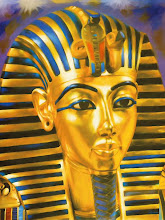
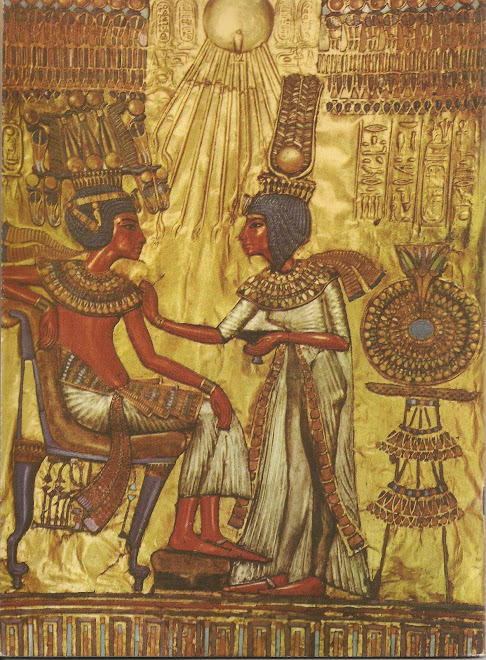
Pharaoh Akhenaten and his family adoring the Aten, second from the left is Meritaten who was the daughter of Akhenaten.
Mostrar mensagens com a etiqueta portas do desconhecido. Mostrar todas as mensagens

quarta-feira, 20 de junho de 2012

Sacerdotes ou Astronautas? (¿Sacerdotes o Cosmonautas?)


Info On Andreas Faber-Kaiser (in spanish...):

Andreas Faber-Kaiser (Barcelona, 5 de abril de 1944 - ibídem, 14 de marzo de 1994) fue un ufólogo y escritor germano-español especializado en la investigación de los aspectos misteriosos y ocultos de nuestra historia, sobre todo en la relación existente de los dioses de la antigüedad con los actuales ovnis, habiendo participado como ponente en numerosos congresos internacionales dedicados a este tipo de temáticas, tanto en Europa como en América.

Biografía

Nació en Barcelona el 5 de abril de 1944, se licenció en Filosofía y letras, obteniendo en 1972 el Premio Nacional de Astronáutica «Julio Marial» por su estudio Repercusión de la astronáutica en la vida del hombre. En 1976 fundó la revista Mundo Desconocido[1] en colaboración con el también desaparecido periodista e investigador argentino Alejandro Vignati, considerada en su momento a nivel mundial como una de las tres primeras publicaciones en su género, y galardonada en 1980 con el premio «Secinter» a la mejor revista especializada. Dejó de publicarse en noviembre de 1982, si bién siguió operando desde entonces como red de investigación internacional, financiando diversos estudios. En verano de 1988 presentó en Catalunya Ràdio el programa ¿Què volen aquesta gent?[2] (¿Que quiere esta gente?), un programa dedicado al mundo de los ovnis. Desde su fundación en 1989 y hasta mayo de 1992 fue Consejero Editorial y Coordinador Internacional de la revista Más Allá de la Ciencia, revista publicada por MC Ediciones y dedicada al mundo del misterio, del esoterismo y la ufología, asimismo también fue Consejero Editorial de JC Ediciones S.A. De 1988 a 1994 dirigió y presentó en Catalunya Ràdio el programa Sintonia Alfa,[2] espacio centrado en temas ufológicos y misteriosos, alternándolo con el programa especial Arxiu Secret[2] (Archivo Secreto).

En agosto de 1992 abrió como primer ponente el Curso Especializado en Extensión Cultural : “Grandes Enigmas: Los Ovnis”, organizado por la Universidad Complutense de Madrid dentro de sus Cursos de Verano y dirigido por J. J. Benítez, constituyendo el primer curso de ufología celebrado en una universidad española.

Sus viajes de investigación le llevaron a buena parte de Europa, Asia, América y Oceanía, consecuencia de ellos son la publicación de algunos de sus libros, como el pólemico Jesús vivió y murió en Cachemira (1976). Un libro donde exponía la posibilidad de que Jesús de Nazaret no hubiera muerto en la cruz, sino que una vez curado de sus graves heridas causadas durante la crucifixión huyera hacia el este en busca de las tribus perdidas de Israel y una vez en Cachemira hubiera comenzado una nueva vida muriendo a un edad muy avanzada de muerte natural.

No menos controvertido fue su libro Pacto de silencio (1988), un libro sobre el Síndrome tóxico, una enfermedad aparecida en 1981 y causada oficialmente por el consumo de aceite de colza desnaturalizado[n. 1] ,consecuencia del fraude alimenticio realizado por unos comerciantes aceiteros, que lo distribuían en venta ambulante como aceite de oliva[n. 2] ,causando 1.100 muertos[n. 3] y más de 60.000 afectados. En este libro intenta demostrar que la causa del Síndrome tóxico no fue el aceite de colza, que era totalmente inocuo, sino la ingesta de tomates tratados con una combinación nematicida organotiofosforada (pesticidas), concretamente con Nemacur® (fenamiphos) y Oftanol® (isofenphos) de la multinacional Bayer, en un ensayo de guerra química pepetrado seguramente por el gobierno de los Estados Unidos.

En su último artículo, publicado en el número 56 (octubre de 1993) de la revista Más Allá de la Ciencia, bajo el título de "Confesiones de Andreas Faber-Kaiser entre la vida y la muerte", reconoció que era portador del virus del sida, sin poderse explicar cómo había podido introducirse en el interior de su cuerpo, y relacionándolo con sus investigaciones sobre el Síndrome tóxico, ya que tanto él como otros investigadores y médicos que intentaron avanzar realmente en el origen de esta extraña dolencia murieron o padecerieron súbitas y extrañas enfermedades.[3]

Andreas Faber-Kaiser murió de sida en el hospital barcelonés de Can Ruti (Hospital Universitario Germans Trias i Pujol) el 14 de marzo de 1994 a los 49 años de edad.

Obras

¿Sacerdotes o cosmonautas? (1971)
Cosmos-Cronología general de la Astronáutica (1972)
Grandes enigmas del Cielo y de la Tierra (1973)
Jesús Vivió y murió en Cachemira (1976)
OVNIs: el archivo de la CIA - Documentación y memorandos (1980)
OVNIs: el archivo de la CIA - Informes de avistamientos (1980)
OVNIs: archivos americanos - Documentos militares y de inteligencia (1980)
La caverna de los tesoros (1984)
Las nubes del engaño [Crónica extrahumana antigua] (1984)
Fuera de control [Crónica extrahumana moderna] (1984)
Sobre el secreto [La isla mágica de Pohnpei y el secreto de Nan Matol] (1985)
Pacto de silencio (1988)
El muñeco humano (1989)

Extracts Source: http://es.wikipedia.org/wiki/Andreas_Faber-Kaiser
 
More Info: http://andreas.faber.cat/ - http://www.bibliotecapleyades.net/vida_alien/revelacion_cosmos/faber.htm - http://es.wikipedia.org/wiki/Extraterrestre - http://www.sebodomessias.com.br/sebo/(S(qvphj4452z20nmz4ym1foh45))/detalheproduto.aspx?idItem=338644


No Rasto de... Os Astronautas do Passado (The Stairway to Heaven)


Info On Zecharia Sitchin:

Zecharia Sitchin (July 11, 1920 – October 9, 2010[1]) was an Azerbaijani-born American author of books proposing an explanation for human origins involving ancient astronauts. Sitchin attributes the creation of the ancient Sumerian culture to the Anunnaki, which he states was a race of extra-terrestrials from a planet beyond Neptune called Nibiru. He believed this hypothetical planet of Nibiru to be in an elongated, elliptical orbit in the Earth's own Solar System, asserting that Sumerian mythology reflects this view. Sitchin's books have sold millions of copies worldwide and have been translated into more than 25 languages.

Sitchin's ideas were rejected by scientists and academics, who dismiss his work as pseudoscience and pseudohistory. Sitchin's work has been criticized for flawed methodology and mistranslations of ancient texts as well as for incorrect astronomical and scientific claims.[2]

Ideas and works

Similarly to earlier authors such as Immanuel Velikovsky and Erich von Däniken, Sitchin advocated hypotheses in which extraterrestrial events supposedly played a significant role in ancient human history.

According to Sitchin's interpretation of Mesopotamian iconography and symbology, outlined in his 1976 book The 12th Planet and its sequels, there is an undiscovered planet beyond Neptune that follows a long, elliptical orbit, reaching the inner solar system roughly every 3,600 years. This planet is called Nibiru (although Jupiter was the planet associated with the god Marduk in Babylonian cosmology).[5] According to Sitchin, Nibiru (whose name was replaced with MARDUK in original legends by the Babylonian ruler of the same name in an attempt to co-opt the creation for himself, leading to some confusion among readers) collided catastrophically with Tiamat (a goddess in the Babylonian creation myth the Enûma Eliš), which he considers to be another planet once located between Mars and Jupiter. This collision supposedly formed the planet Earth, the asteroid belt, and the comets. Sitchin states that when struck by one of planet Nibiru's moons, Tiamat split in two, and then on a second pass Nibiru itself struck the broken fragments and one half of Tiamat became the asteroid belt. The second half, struck again by one of Nibiru's moons, was pushed into a new orbit and became today's planet Earth.

According to Sitchin, Nibiru (called "the twelfth planet" because, Sitchin claimed, the Sumerians' gods-given conception of the Solar System counted all eight planets, plus Pluto, the Sun and the Moon) was the home of a technologically advanced human-like extraterrestrial race called the Anunnaki in Sumerian myth, who Sitchin states are called the Nephilim in Genesis. He wrote that they evolved after Nibiru entered the solar system and first arrived on Earth probably 450,000 years ago, looking for minerals, especially gold, which they found and mined in Africa. Sitchin states that these "gods" were the rank-and-file workers of the colonial expedition to Earth from planet Nibiru.

Sitchin wrote that Enki suggested that to relieve the Anunnaki, who had mutinied over their dissatisfaction with their working conditions, that primitive workers (Homo sapiens) be created by genetic engineering as slaves to replace them in the gold mines by crossing extraterrestrial genes with those of Homo erectus.[6][7] According to Sitchin, ancient inscriptions report that the human civilization in Sumer, Mesopotamia, was set up under the guidance of these "gods", and human kingship was inaugurated to provide intermediaries between mankind and the Anunnaki (creating the "divine right of kings" doctrine). Sitchin believes that fallout from nuclear weapons, used during a war between factions of the extraterrestrials, is the "evil wind" described in the Lament for Ur that destroyed Ur around 2000 BC. Sitchin states the exact year is 2024 BC.[8] Sitchin says that his research coincides with many biblical texts, and that biblical texts come originally from Sumerian writings.

Popularity

Since the release of his first book The 12th Planet in 1976, now in its 45th printing, Zecharia Sitchin has written seven other books as part of his Earth Chronicles series, as well as six other companion books, all of which are still in print as of 2010[update]. Sitchin's books have sold millions of copies worldwide and been published in more than 25 languages, as well as in braille.[9] New York Times reporter Corey Kilgannon noted that despite academic dismissal of his work, Sitchin has "a devoted following of readers".[3]

Critic Michael Heiser called Sitchin "arguably the most important proponent of the ancient astronaut hypothesis over the last several decades".[10] Sitchin was a frequent guest on the Coast to Coast AM radio show, which in 2010 presented Sitchin with a lifetime achievement award.[11] Gods of the New Millennium author Alan F. Alford admits he initially became "infatuated" with Sitchin's hypotheses but later became a critic of Sitchin's interpretations of myth.[12]

According to some writers, Sitchin's ideas along with those of Erich von Däniken may have influenced the beliefs of the religious sect of Raëlism,[13][14] and writer Mark Pilkington sees the mythology of Japan's Pana Wave religious group as rooted in Sitchins The 12th Planet and its sequels.[15]

The 1994 movie Stargate, directed by Roland Emmerich, and the 2009 video game The Conduit drew some conceptual inspiration from Sitchin's ideas,[16][17] while screenwriter Roberto Orci says the villains of the film Cowboys & Aliens were inspired by Sitchin's conceptualization of the Anunnaki as gold-mining aliens.[18]

Criticisms

Criticism of Sitchin's work falls primarily into three categories: translations and interpretations of ancient texts; astronomical and scientific observations; and literalism of myth.

Translations and interpretations

When Sitchin wrote his books, only specialists could read the Sumerian language. However, sources such as the 2006 book Sumerian Lexicon[19] have made the language more accessible to non-experts. Ancient language scholar Michael S. Heiser[20] states he has found many inaccuracies in Sitchin's translations and challenges interested parties to use this book to check their validity.[15][21] Prof. Ronald H. Fritze,[22] author of the book Invented Knowledge: False History, Fake Science and Pseudo-religions,[22] mentions the example of Sitchin's claim that the Sumerian sign Din-Gir means "pure ones of the blazing rockets", adding that "Sitchin's assignment of meanings to ancient words is tendentious and frequently strained."[23] Fritze also commented on Sitchin's methodology, writing that "When critics have checked Sitchin's references, they have found that he frequently quotes out of context or truncates his quotes in a way that distorts evidence in order to prove his contentions. Evidence is presented selectively and contradictory evidence is ignored."[23]

Sitchin bases his arguments on his personal interpretations of pre-Nubian and Sumerian texts, and the seal VA 243. Sitchin wrote that these ancient civilizations knew of a twelfth planet, when in fact they only knew five.[24] Hundreds of Sumerian astronomical seals and calendars have been decoded and recorded, and the total count of planets on each seal has been five. Seal VA 243 has 12 dots that Sitchin identifies as planets. When translated, seal VA 243 reads "You're his Servant" which is now thought to be a message from a nobleman to a servant. According to semitologist Michael S. Heiser, the so-called sun on Seal VA 243 is not the Sumerian symbol for the sun but is a star, and the dots are also stars.[24][25] The symbol on seal VA 243 has no resemblance to the hundreds of documented Sumerian sun symbols.

In a 1979 review of The Twelfth Planet, Roger W. Wescott,[26] Prof. of Anthropology and Linguistics at Drew University, Madison, New Jersey, noted Sitchin's amateurishness with respect to the primacy of the Sumerian language:

Sitchin's linguistics seems at least as amateurish as his anthropology, biology, and astronomy. On p. 370, for example, he maintains that "all the ancient languages . . . including early Chinese . . . stemmed from one primeval source -- Sumerian". Sumerian, of course, is the virtual archetype of what linguistic taxonomists call a language-isolate, meaning a language that does not fall into any of the well-known language-families or exhibit clear cognation with any known language. Even if Sitchin is referring to written rather than to spoken language, it is unlikely that his contention can be persuasively defended, since Sumerian ideograms were preceded by the Azilian and Tartarian signaries of Europe as well as by a variety of script-like notational systems between the Nile and Indus rivers.[27]

Astronomical and scientific observations

Sitchin's "planetary collision" view does superficially resemble a theory by modern astronomers—the giant impact theory of the Moon's formation about 4.5 billion years ago by a body impacting with the newly-formed Earth. However, Sitchin's proposed series of rogue planetary collisions differ in both details and timing. As with Immanuel Velikovsky's earlier Worlds in Collision thesis, Sitchin states that he has found evidence of ancient human knowledge of rogue celestial motions in a variety of mythological accounts. In Velikovsky's case, these interplanetary collisions were supposed to have taken place within the span of human existence, whereas for Sitchin these occurred during the early stages of planetary formation, but entered the mythological account passed down via the alien race which purportedly evolved on Nibiru after these encounters.

While Sitchin's scenario for the creation of the Solar System is hard to reconcile with the Earth's current small orbital eccentricity of only 0.0167, Sitchin's supporters maintain that it would explain much of Earth's peculiar early geography due to cleaving from the celestial collision, i.e., solid continents on one side and a giant ocean on the other.[citation needed]

According to former Immanuel Velikovsky assistant turned prolific critic,[28] C. Leroy Ellenberger,[28] "[Sitchin states that] from an equal start, the Nefilim evolved on Nibiru 45 million years ahead of comparable development on Earth with its decidedly more favorable environment. Such an outcome is unlikely, to say the least, since Nibiru would spend over 99% of its time beyond Pluto. Sitchin's explanation that heat from radioactive decay and a thick atmosphere keep Nibiru warm is absurd and does not address the problem of darkness in deep space. Also unexplained is how the Nefilim, who evolved long after Nibiru arrived, knew what happened when Nibiru first entered the solar system."[29]

The scenario outlined by Sitchin, with Nibiru returning to the inner solar system regularly every 3,600 years,

. . . implies an orbit with a semi-major axis of 235 astronomical units, extending from the asteroid belt to twelve times farther beyond the sun than Pluto. Elementary perturbation theory indicates that, under the most favorable circumstances of avoiding close encounters with other planets, no body with such an eccentric orbit would keep the same period for two consecutive passages. Within twelve orbits the object would be either ejected or converted to a short period object. Thus, the failed search for a trans-Plutonian planet by T.C. Van Flandern, of the U.S. Naval Observatory, which Sitchin uses to bolster his thesis, is no support at all.[29]

Sitchin in “the case of Adam’s alien genes”[30] states that 223 unique genes found by the Human Genome Sequencing Consortium are without the required predecessors on the genomic evolutionary tree. Later researchers have argued that the conclusion from the Human Genome Sequencing Consortium cannot be drawn due to a lack of a comprehensive gene database for comparison. An analysis by Salzberg identified 40 potential genes laterally transferred into the genome from prokaryotic organisms. Salzberg also argues that gene loss combined with sample size effects and evolutionary rate variation provide an alternative, more biologically plausible explanation.[31]

Literalism of myth

Peter James, co-author of the controversial book Centuries of Darkness,[32] has criticized Sitchin both for ignoring the world outside of Mesopotamia and more specifically for misunderstanding Babylonian literature:

He uses the Epic of Creation Enuma Elish as the foundation for his cosmogony, identifying the young god Marduk, who overthrows the older regime of gods and creates the Earth, as the unknown "Twelfth Planet". In order to do as he interprets the Babylonian theogony as a factual account of the birth of the other "eleven" planets. The Babylonian names for the planets are established beyond a shadow of a doubt—Ishtar was the deity of Venus, Nergal of Mars, and Marduk of Jupiter—and confirmed by hundreds of astronomical/astrological tables and treatises on clay tablets and papyri from the Hellenistic period. Sitchin merrily ignores all this and assigns unwarranted planetary identities to the gods mentioned in the theogony. For example, Apsu, attested as god of the primeval waters, becomes, of all things, the Sun! Ea, as it suits Sitchin, is sometimes planet Neptune and sometimes a spaceman. And the identity of Ishtar as the planet Venus, a central feature of Mesopotamian religion, is nowhere mentioned in the book—instead Sitchin arbitrarily assigns to Venus another deity from Enuma Elish, and reserves Ishtar for a role as a female astronaut.[33]

William Irwin Thompson comments on what he calls Sitchin's 'literalism':

What Sitchin sees is what he needs for his hypothesis. So figure 15 on page 40 is radiation therapy, and figure 71 on page 136 is a god inside a rocket-shaped chamber. If these are gods, why are they stuck with our cheap B movie technology of rockets, microphones, space-suits, and radiation therapy? If they are gods, then why can't they have some really divine technology such as intradimensional worm-hole travel, antigravity, starlight propulsion, or black hole bounce rematerializations? Sitchin has constructed what appears to be a convincing argument, but when he gets close to single images on ancient tablets, he falls back into the literalism of "Here is an image of the gods in rockets." Suddenly, ancient Sumer is made to look like the movie set for Destination Moon. Erich Von Däniken's potboiler Chariots of the Gods? has the same problem. The plain of Nazca in Peru is turned into a World War II landing strip. The gods can cross galactic distances, but by the time they get to Peru, their spaceships are imagined as World War II prop jobs that need an enormous landing strip. This literalization of the imagination doesn't make any sense, but every time it doesn't, you hear Sitchin say "There can be no doubt, but..."[34]

Extracts Source: http://en.wikipedia.org/wiki/Zecharia_Sitchin

More Info: http://www.sitchin.com/ - http://www.sitchiniswrong.com/ - http://en.wikipedia.org/wiki/Extraterrestrial_hypothesis - http://en.wikipedia.org/wiki/Mesopotamian_mythology - http://en.wikipedia.org/wiki/Sumerian_literature


quinta-feira, 26 de abril de 2012

A Derradeira Catástrofe - Deslocação Polar (Pole Shift)


Info On The Pole Shift Hypothesis:

The cataclysmic pole shift hypothesis suggests that there have been geologically rapid shifts in the relative positions of the modern-day geographic locations of the poles and the axis of rotation of the Earth, creating calamities such as floods and tectonic events.[1]

There is evidence of precession and changes in axial tilt, but this change is on much longer time-scales and does not involve relative motion of the spin axis with respect to the planet.[citation needed] However, in what is known as true polar wander, the solid Earth can rotate with respect to a fixed spin axis. Research shows that during the last 200 million years a total true polar wander of some 30° has occurred, but that no super-rapid shifts in the Earth's pole were found during this period.[2] A characteristic rate of true polar wander is 1° per million years or less.[3] Between approximately 790 and 810 million years ago, when the supercontinent Rodinia existed, two geologically-rapid phases of true polar wander may have occurred. In each of these, the magnetic poles of the Earth shifted by ~55°.[4]

Definition and clarification

The geographic poles of the Earth are the points on the surface of the planet that are intersected by the axis of rotation. The pole shift hypothesis describes a change in location of these poles with respect to the underlying surface – a phenomenon distinct from the changes in axial orientation with respect to the plane of the ecliptic that are caused by precession and nutation, and from true polar wander.

Pole shift hypotheses are not connected with plate tectonics, the well-accepted geological theory that the Earth's surface consists of solid plates which shift over a fluid asthenosphere; nor with continental drift, the corollary to plate tectonics which maintains that locations of the continents have moved slowly over the face of the Earth,[5] resulting in the gradual emerging and breakup of continents and oceans over hundreds of millions of years.[6]

Pole shift hypotheses are not the same as geomagnetic reversal, the periodic reversal of the Earth's magnetic field (effectively switching the north and south magnetic poles).

Speculative history

In popular literature, many conjectures have been suggested involving very rapid polar shift. A slow shift in the poles would display the most minor alterations and no destruction. A more dramatic view assumes more rapid changes, with dramatic alterations of geography and localized areas of destruction due to earthquakes and tsunamis.

Early proponents

An early mention of a shifting of the Earth's axis can be found in an 1872 article entitled "Chronologie historique des Mexicains"[7] by Charles Étienne Brasseur de Bourbourg, a specialist in Mesoamerican codices who interpreted ancient Mexican myths as evidence for four periods of global cataclysms that had begun around 10,500 B.C.

In 1948, Hugh Auchincloss Brown, an electrical engineer, advanced a hypothesis of catastrophic pole shift. Brown also argued that accumulation of ice at the poles caused recurring tipping of the axis, identifying cycles of approximately seven millennia.[8][9]

In his controversial 1950 work Worlds in Collision, Immanuel Velikovsky postulated that the planet Venus emerged from Jupiter as a comet. During two proposed near approaches in about 1,450 B.C., he suggested that the direction of the Earth's rotation was changed radically, then reverted to its original direction on the next pass. This disruption supposedly caused earthquakes, tsunamis, and the parting of the Red Sea. Further, he said near misses by Mars between 776 and 687 B. C. also caused the Earth's axis to change back and forth by ten degrees. Velikovsky supported his work with historical records, although his studies were mainly ridiculed by the scientific community.[10]

Charles Hapgood is now perhaps the best remembered early proponent. In his books The Earth's Shifting Crust (1958) (which includes a foreword by Albert Einstein that was written before the theory of plate tectonics was developed)[11] and Path of the Pole (1970). Hapgood, building on Adhemar's much earlier model,[citation needed] speculated that the ice mass at one or both poles over-accumulates and destabilizes the Earth's rotational balance, causing slippage of all or much of Earth's outer crust around the Earth's core, which retains its axial orientation.

Based on his own research, Hapgood argued that each shift took approximately 5,000 years, followed by 20,000- to 30,000-year periods with no polar movements. Also, in his calculations, the area of movement never covered more than 40 degrees. Hapgood's examples of recent locations for the North Pole include Hudson Bay (60˚N, 73˚W) , the Atlantic Ocean between Iceland and Norway (72˚N, 10˚E) and Yukon (63˚N, 135˚W).

However, in his subsequent work The Path of the Pole, Hapgood conceded Einstein's point that the weight of the polar ice would be insufficient to bring about a polar shift. Instead, Hapgood argued that the forces that caused the shifts in the crust must be located below the surface. He had no satisfactory explanation for how this could occur.[12]

Hapgood wrote to a Canadian librarian, Rand Flem-Ath, encouraging him in his pursuit of scientific evidence to back Hapgood's claims and in his expansion of the hypothesis. Flem-Ath published the results of this work in 1995 in When the Sky Fell co-written with his wife.[13]

Recent conjectures

The field has attracted pseudoscientific authors offering a variety of evidence, including psychic readings.

In the 1970s and 1980s a series of books not intended as fiction by former Washington newspaper reporter Ruth Shick Montgomery elaborates on Edgar Cayce readings.[14]

In 1997 Richard W. Noone published 5/5/2000, ICE: The Ultimate Disaster. This book argued that a cataclysmic shift of the Earth's ice cap covering Antarctica caused by a planetary alignment and solar storms, would lead to crustal displacement on May 5, 2000.[15]

In 1998 retired civil engineer James G. Bowles proposed in Atlantis Rising magazine a mechanism by which a polar shift could occur. He named this Rotational-Bending, or the RB-effect. He hypothesized that combined gravitational effects of the Sun and the Moon pulled at the Earth's crust at an oblique angle. This force steadily wore away at the underpinnings that linked the crust to the inner mantle. This generates a plastic zone that allows the crust to rotate with respect to the lower layers. Centrifugal forces will act on the mass of ice at the poles, causing them to move to the equator.[16]

Books on this subject have been published by William Hutton, including the 1996 book Coming Earth Changes: Causes and Consequences of the Approaching Pole Shift (ISBN 0876043619), which compared geologic records with the psychic readings of Edgar Cayce and predicted catastrophic climate changes before the end of 2001. In 2004 Hutton and co-author Jonathan Eagle published Earth's Catastrophic Past and Future: A Scientific Analysis of Information Channeled by Edgar Cayce (ISBN 1-58112-517-8), which summarizes possible mechanisms and the timing of a future pole shift.

Scientific research

It is now established that true polar wander has occurred at various times in the past, but at rates of 1° per million years or less.[2][3][17] Analysis of the evidence does not lend credence to Hapgood's hypothesized rapid displacement of layers of the Earth.[18] Although Hapgood drastically overestimated the effects of changing mass distributions across the Earth,[citation needed] calculations show that changing mass distributions both on the surface and in the mantle can cause true polar wander.

True polar wander
( http://en.wikipedia.org/wiki/True_polar_wander )

True polar wander, or the motion of the solid Earth with respect to a fixed spin axis that causes the spin axis to lie over a new geographic position, does occur. This is because of changes in mass distribution throughout the Earth that modify its moment of inertia tensor. The Earth consistently readjusts its orientation with respect to its spin axis such that its spin axis is parallel to the axis about which it has its greatest moment of inertia.[4] This readjustment is very slow. In 2001, historical evidence for true polar wander was found in paleomagnetic data from granitic rocks from across North America. The data from these rocks conflict with the hypothesis of a cataclysmic true polar wander event. This evidence indicated that the geographical poles have not deviated by more than about 5° over the last 130 million years.[19] More rapid past possible occurrences of true polar wander have been measured: from 790 to 810 million years ago, true polar wander of approximately 55° may have occurred twice.[4]

Causes and effects

True polar wander can be caused by several mechanisms of redistributing mass and changing the moment of inertia tensor of the Earth:

- Glacial cycles: redistribution of ice and water masses, and resultant deformation of the crust, changes the mass distribution around the Earth.[20]

- Perturbations of the topography of the core-mantle boundary, perhaps induced by differential core rotation and shift of its axial rotation vector, leading to CMB mass redistributions.[21]

- Mass redistributions in the mantle.[22][23]

- The orientation of the rotational axis itself could be changed by the high-velocity impact of a massive asteroid or comet.[24]

See also
 
Doomsday event
( http://en.wikipedia.org/wiki/Doomsday_event )
Earth Changes
( http://en.wikipedia.org/wiki/Earth_Changes )
Geomagnetic reversal
( http://en.wikipedia.org/wiki/Geomagnetic_reversal )
North Magnetic Pole
( http://en.wikipedia.org/wiki/North_Magnetic_Pole )
South Magnetic Pole
( http://en.wikipedia.org/wiki/South_Magnetic_Pole )
Tollmann's hypothetical bolide
( http://en.wikipedia.org/wiki/Tollmann%27s_hypothetical_bolide )

Extract Source: http://en.wikipedia.org/wiki/Pole_shift_hypothesis

More Info: http://www.bertrand.pt/ficha/a-derradeira-catastrofe?id=67907 & http://www.wook.pt/ficha/a-derradeira-catastrofe/a/id/67907

sexta-feira, 6 de abril de 2012

Estranhos Sequestros (No Rasto De...)


General Info On Alien Abductions:

The terms alien abduction or abduction phenomenon describe "subjectively real memories of being taken secretly against one’s will by apparently nonhuman entities and subjected to complex physical and psychological procedures."[1] People claiming to have been abducted are usually called "abductees" or "experiencers." Typical claims involve being subjected to a forced medical examination that emphasizes their reproductive system.[2] Abductees sometimes claim to have been warned against environmental abuse and the dangers of nuclear weapons.[3] Consequently, while many of these purported encounters are described as terrifying, some have been viewed as pleasurable or transformative.

Due to a lack of any substantial physical evidence, most scientists and mental health professionals dismiss the phenomenon as "deception, suggestibility (fantasy-proneness, hypnotizability, false-memory syndrome), personality, sleep phenomena, psychopathology, psychodynamics [and] environmental factors.".[4] Skeptic Robert Sheaffer also sees similarity between the aliens depicted in early science fiction films, in particular, Invaders From Mars, and those reported to have actually abducted people.[5]

The first alien abduction claim to be widely publicized was the Betty and Barney Hill abduction in 1961.[6] Reports of the abduction phenomenon have been made around the world, but are most common in English speaking countries, especially the United States.[5] The contents of the abduction narrative often seem to vary with the home culture of the alleged abductee.[5]

Alien abductions have been the subject of conspiracy theories and science fiction storylines (notably The X-Files) which have speculated on stealth technology required if the phenomenon were real, the motivations for secrecy and that alien implants could be a possible form of physical evidence.


Contents


1 Overview
2 History
2.1 Paleo-abductions
2.2 Contactees
2.3 Two landmark cases
2.4 Later developments
2.4.1 John Mack
3 Abductors
3.1 Motivations
4 Abductees
4.1 Paranormal
4.2 Demographics
5 The abduction narrative
5.1 Capture
5.2 Examination
5.3 Subsequent abduction procedures
5.3.1 Child presentation
5.4 Less common elements
5.5 Return
5.6 Realization event
6 Trauma and recovery
6.1 Support groups
6.2 Therapeutical Hypnosis
7 Perspectives
7.1 Skeptical perspectives
7.1.1 Examples
7.2 Paranormal and conspiratorial
7.3 Testimonials
7.4 Attempts at confirmation
8 Notable abduction claims
9 Notable figures
10 See also
11 Footnotes
12 Further reading
13 External links


ExtractInfo & Other Article Links: http://en.wikipedia.org/wiki/Alien_abduction ; http://en.wikipedia.org/wiki/History_of_alien_abduction_claims ; http://en.wikipedia.org/wiki/Contactee ; http://en.wikipedia.org/wiki/Abduction_phenomenon_entities ; http://en.wikipedia.org/wiki/Abduction_claimants ; http://en.wikipedia.org/wiki/Narrative_of_the_abduction_phenomenon ; http://en.wikipedia.org/wiki/Missing_time ; http://en.wikipedia.org/wiki/Perspectives_on_the_abduction_phenomenon ; http://en.wikipedia.org/wiki/Alien_implants .

More (Inside) Info: http://abraxaznihilnones.blogspot.pt/2010/11/allen-greenfield-selected-works.html ; http://abraxaznihilnones.blogspot.pt/2010/11/alien-autopsy.html ; http://abraxaznihilnones.blogspot.pt/2010/11/area-51-alien-interview.html ; http://abraxaznihilnones.blogspot.pt/2010/11/x-files-confidential.html ; http://abraxaznihilnones.blogspot.pt/2010/10/big-book-of-conspiracies.html ; http://abraxaznihilnones.blogspot.pt/2010/10/big-book-of-unexplained.html .


quarta-feira, 20 de abril de 2011

As Missas Negras


General Info:

A Black Mass is a ceremony supposedly celebrated during the Witches' Sabbath, which was a sacrilegious parody of the Catholic Mass.[1] Its main objective was the profanation of the host, although there is no agreement among authors on how hosts were obtained or profaned; the most common idea is that they were profaned by means of some ritual related to sexual practices.[2] Authors also disagree on which rites were performed during the ceremony.[2] Some medieval writers believed that the host was replaced by a toad, a turnip or a piece of dry flesh, but most judges and authors believed that true hosts were given by Christian priests, who had made diabolical pacts, to the attendants of the Sabbath to be profaned by them.[2]


It is not clear if the Black Mass was ever celebrated in medieval times; the works referring to them are lurid and unreliable sources such as the Malleus Maleficarum, and it may have served solely as a shocking act with which to accuse enemies.

Extract Source: http://en.wikipedia.org/wiki/Black_Mass


MoreInfo:

Os Segredos da Magia


InfoLinks:
http://www.magicinternacional.com/prensa/Bio-SebastiaDArbo.pdf
http://campusvirtual.unex.es/cala/epistemowikia/index.php?title=Sebasti%C3%A1n_D'Arb%C3%B3
http://www.quintadimension.com/article179.html
http://www.darbo.org/